
You're on site, the crew is ready, and then someone spots it. The architectural set shows one detail. The structural drawing shows another. The shop is asking what to fabricate, the foreman wants an answer now, and everyone starts doing what construction teams always do under pressure. They call, text, mark up a PDF, and try to sort it out fast.
That's the moment people start asking about rfi meaning in construction.
The mistake is thinking an RFI is just a formal way to ask a question. It isn't. In practice, it's the controlled process that stops a live problem from turning into rework, argument, or a claim later. If the answer matters to cost, sequence, compliance, or what gets built in the field, a hallway chat isn't enough. You need a project record that shows what was unclear, who answered, what documents were referenced, and which instruction the team relied on.
Table of Contents
- Why a Simple Question Is Not Simple in Construction
- Defining the Core Purpose of a Request for Information
- Navigating the RFI Lifecycle and Key Roles
- Clarifying RFI vs Submittal vs Change Order
- Writing Effective RFIs That Get Clear Answers
- Avoiding Common RFI Pitfalls and Delays
- How Modern Platforms Streamline the RFI Process
Why a Simple Question Is Not Simple in Construction
A concreter doesn't stop a pour because they enjoy paperwork. Work stops because someone has hit an uncertainty that affects what gets built. That uncertainty might be a missing dimension, a clash between disciplines, or a note that doesn't line up with the specification. Once that happens, every informal answer creates risk.
In Australia, an RFI is a formal, documented mechanism used to resolve unclear, missing, or conflicting contract information during construction, not a casual site conversation. That formality matters in an industry of this scale. Australia's construction industry accounted for about 8.7% of GDP in 2023-24, and total construction work done was valued at roughly A$346.7 billion in the 2024 financial year, according to this Australian construction RFI overview.
On a project, that scale shows up as pressure. One unclear detail can hold a trade. One delayed response can throw out a sequence. One undocumented instruction can leave the contractor exposed when someone later asks why the work was installed that way.
The site conversation problem
Most junior PMs learn this the hard way. A consultant gives a verbal answer. The supervisor passes it on. The crew builds to it. Two weeks later, a revised drawing lands or another consultant says that wasn't the intent. Now the team is arguing over memory instead of checking a record.
Practical rule: If the answer affects design intent, scope interpretation, compliance, sequencing, procurement, or installation, it belongs in an RFI.
That's the meaning behind the term. An RFI protects progress by slowing down the right decision just enough to document it properly.
Why formality protects everyone
A good RFI does three things at once:
- It isolates the issue so nobody is guessing what needs clarification.
- It assigns responsibility so the right party answers it.
- It creates a trail that the site team, consultants, and contract administrator can all rely on later.
What doesn't work is treating RFIs like email traffic. The project doesn't need more messages. It needs one reliable record of the question and one reliable record of the answer.
Defining the Core Purpose of a Request for Information
An RFI is best thought of as the project's formal referee call. Play stops for a reason. The relevant documents get checked. A ruling is made. Then everyone restarts from the same position.
That's why the rfi meaning in construction isn't “asking for information” in the casual sense. In Australian practice, it's a controlled contract-administration mechanism for closing information gaps in drawings, specifications, and coordination details before work proceeds, as outlined in this explanation of RFIs in construction practice.
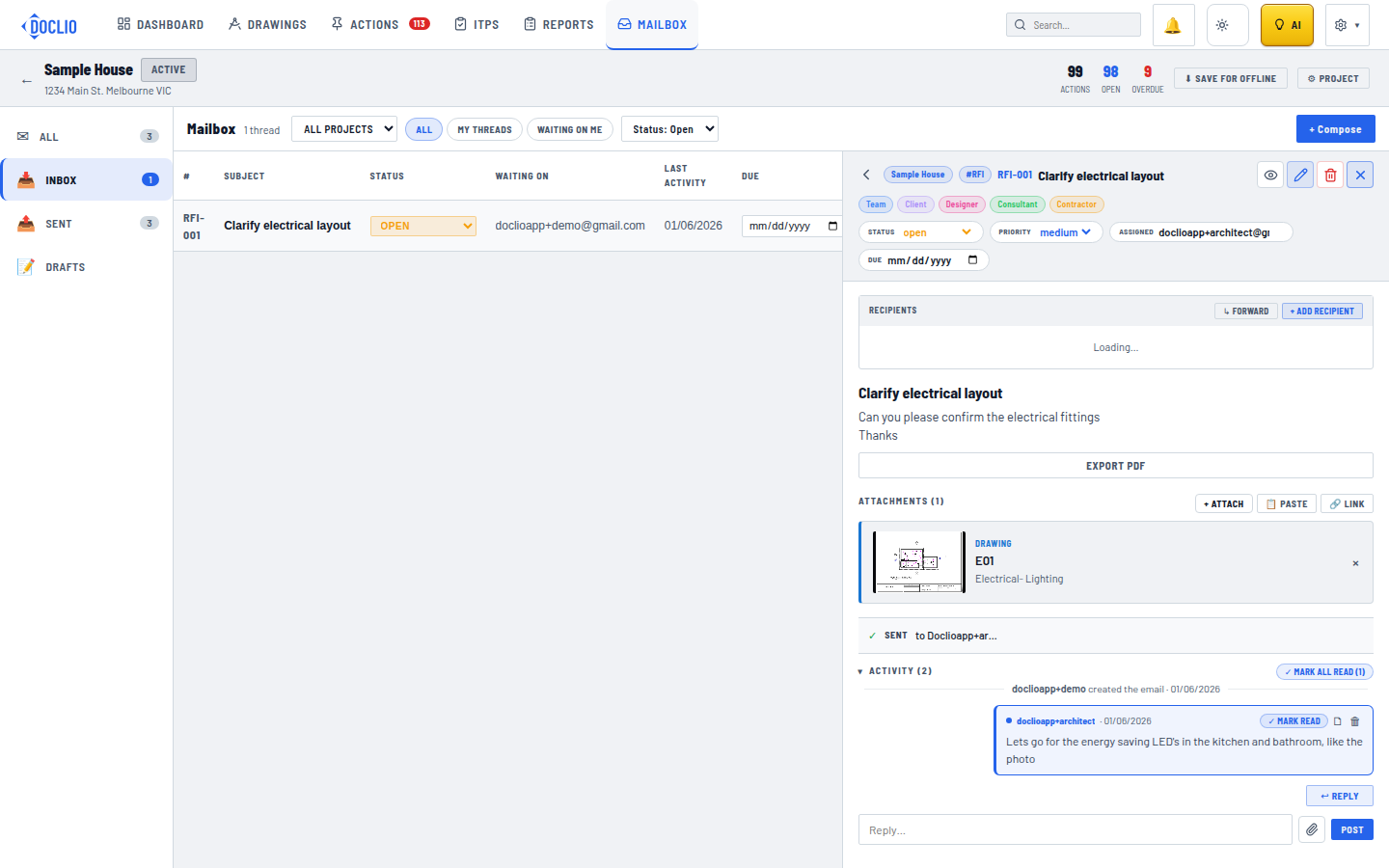
That controlled part is where many teams slip. They think the value sits in the question. It doesn't. The value sits in making the answer traceable, versioned, and tied back to the exact contract documents in dispute.
What an RFI is actually for
An RFI should be used when the contract documents leave a genuine gap such as:
- An ambiguity in the drawings where two interpretations are possible.
- A missing specification requirement needed before procurement or installation.
- A conflict between documents such as architecture, structure, services, or civil information not aligning.
- A coordination issue where one discipline's design affects another trade's work.
It should not be used to smuggle in a scope change. If the answer changes the scope, cost, or time, that usually needs a separate instruction, direction, or variation pathway. That distinction matters because an RFI clarifies existing intent. It doesn't authorise new work by itself.
Why the project record matters more than the question
Australian protocols generally treat RFIs as formal correspondence that should be traceable and linked to the relevant contract material. In practical terms, that means a useful RFI includes exact references, not loose descriptions.
A solid RFI usually names:
| Item | Why it matters |
|---|---|
| RFI number | Lets the team track and close the issue cleanly |
| Drawing or spec reference | Shows exactly what is unclear |
| Location | Stops broad answers to local problems |
| Proposed interpretation | Helps the reviewer confirm or reject quickly |
| Response deadline | Makes the urgency visible |
An RFI should leave no room for the responder to ask, “Which sheet are you talking about?”
That's why experienced PMs push back on vague wording. The more precise the RFI, the more usable the answer becomes in the field.
Navigating the RFI Lifecycle and Key Roles
A lot of confusion around RFIs comes from not knowing where one starts, who should answer it, and who has to act on the response. The process is simple when the team is disciplined. It becomes messy when everyone assumes someone else owns the next step.
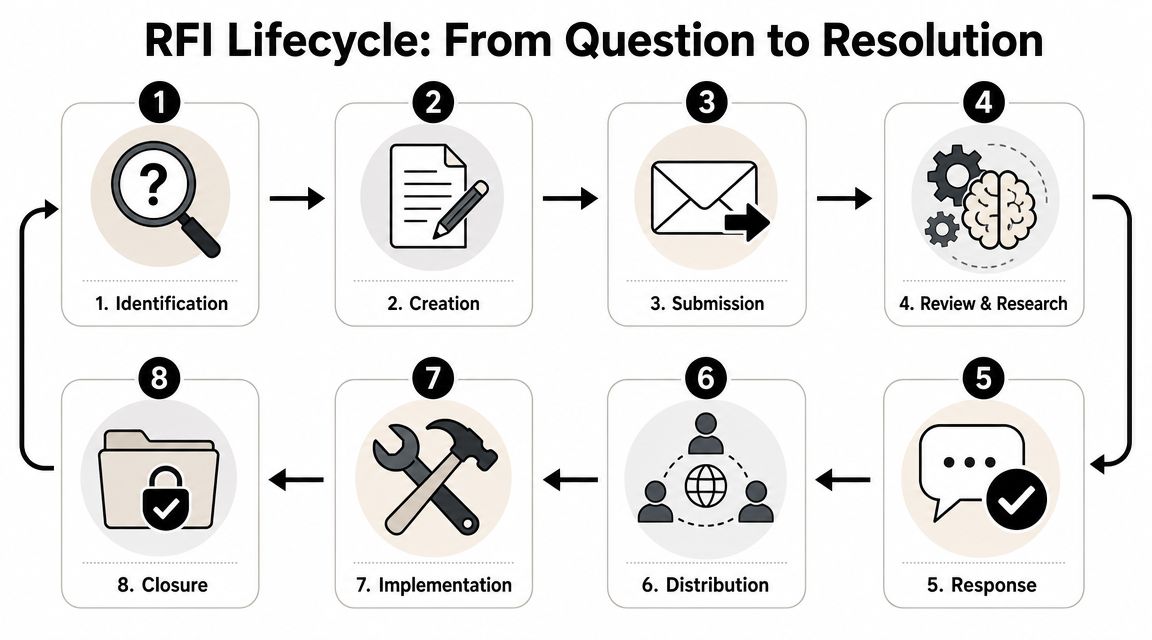
Where an RFI starts
Most RFIs begin in the field or during trade coordination. A supervisor, engineer, subcontractor, or detailer sees something that can't be built confidently from the current documents.
The path should look like this:
Identify the issue
Someone spots unclear, missing, or conflicting information.Draft the RFI
The contractor or subcontractor records the issue with references, markups, and a clear question.Submit it formally
The RFI goes through the agreed project channel, usually via the contractor to the architect, engineer, or contract administrator.Review by the responsible party
The design team or administrator checks the documents, coordinates internally if needed, and prepares an answer.
Before looking at the rest of the cycle, this visual gives a useful overview of how the handoffs work on a live project.
Issue the response
The answer is documented and sent back through the same formal path.Distribute to affected parties
The contractor shares it with the relevant trades, supervisors, and document controllers.Implement the answer
The team builds, procures, revises, or holds work based on the response.Close and archive
The RFI is logged as closed and kept with the project record.
Who owns what
The lifecycle only works when roles stay clear.
- Subcontractor or site engineer often identifies the problem first. Their job is to raise the issue early and provide enough detail to avoid a vague query.
- Head contractor PM or contract administrator usually filters and formalises the RFI, ensuring weak RFIs are cleaned up before they go out.
- Architect or lead consultant often coordinates the response where design intent is involved.
- Structural, MEP, civil, or specialist engineers answer discipline-specific technical questions.
- Site team implements the answer, but only after it has been issued formally and the latest document set is clear.
A common failure point is bypassing the contractor's control process. If trades send direct questions to consultants without central logging, the team ends up with split records and inconsistent instructions.
On site test: If the foreman asks, “Which answer are we building to?”, the process has already drifted.
Another failure point is letting an answered RFI die in someone's inbox. The response only has value when the field team sees it, understands it, and applies it against the current revision set.
Clarifying RFI vs Submittal vs Change Order
These three documents get mixed up constantly. When teams use the wrong one, they create delay first and argument later.
The short version is simple. An RFI asks for clarification. A submittal provides information for review or approval. A change order changes the commercial or contractual position of the work.
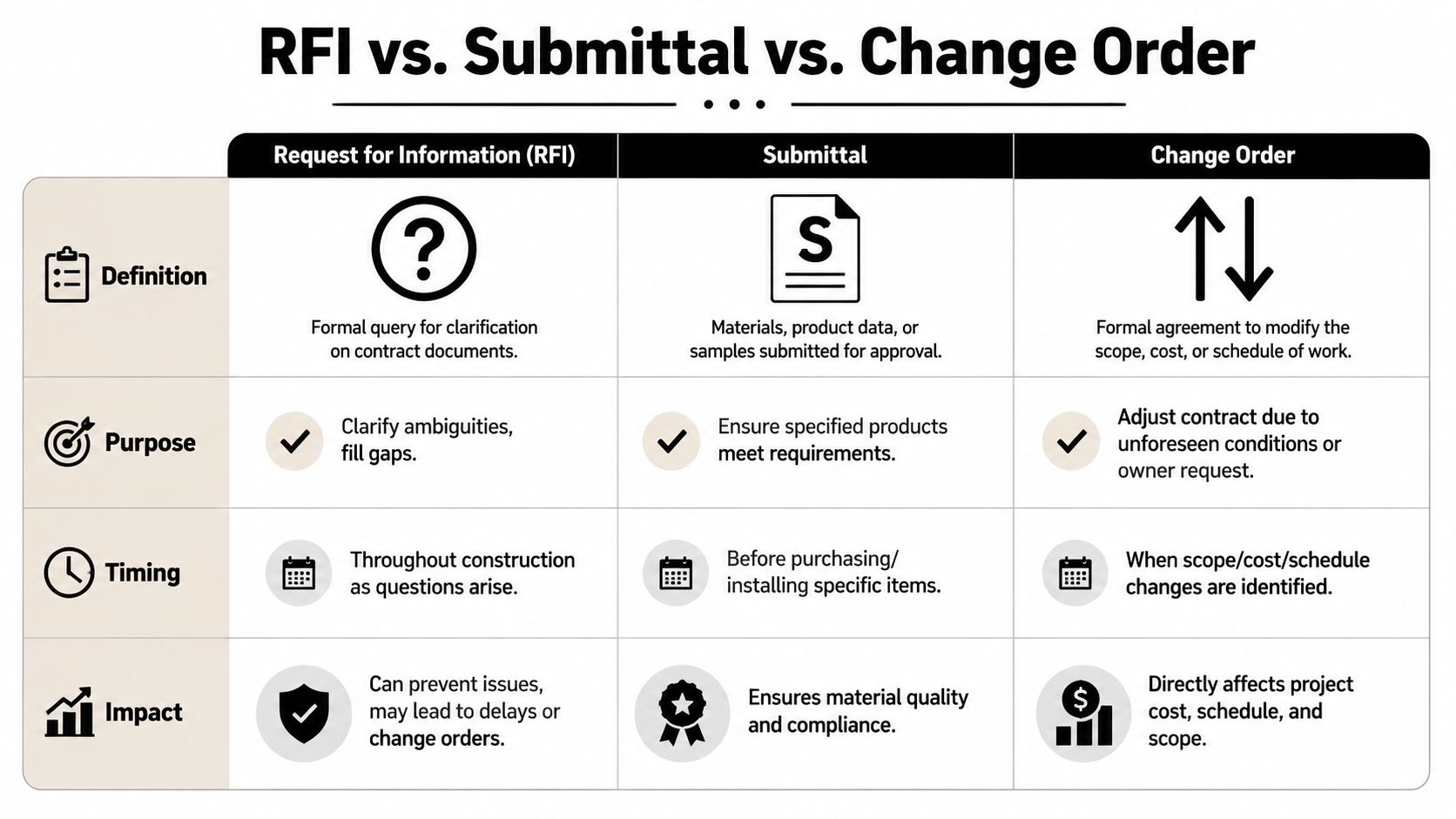
A quick side by side view
| Document | Main purpose | Typical trigger | Contract effect |
|---|---|---|---|
| RFI | Clarify ambiguity or missing information | Unclear drawings, specs, or coordination detail | Clarifies intent. May lead to another process if scope changes |
| Submittal | Present product data, shop drawings, samples, or details for review | Before fabrication, purchase, or installation | Supports compliance and review of proposed materials or details |
| Change order | Formally modify scope, cost, time, or method authorised under the contract | Directed change, latent condition, revised requirement | Changes the project's contractual terms |
The practical test
If you're unsure which document to use, ask one question.
Are you asking what the documents mean, showing what you intend to supply, or changing what the contract requires?
That split usually clears it up fast.
Use an RFI when the contract documents don't give a reliable basis to proceed.
Use a submittal when the documents are clear and you're providing evidence that your product or fabrication approach complies.
Use a change order when someone is altering scope, time, cost, or another contractual obligation.
What doesn't work is trying to make one document do another's job.
- An RFI shouldn't be used to seek approval for a product substitution.
- A submittal shouldn't be used to ask the designer to fill in missing design.
- A change order shouldn't be implied through a loosely worded RFI response.
That last point causes real trouble. If an RFI answer appears to alter scope, the PM needs to stop and route the commercial consequence through the proper variation or direction process. Otherwise the site builds on one record while the contract file says something else.
Writing Effective RFIs That Get Clear Answers
A good RFI is narrow, specific, and easy to answer. A bad one is broad, emotional, and forces the reviewer to work out what you meant. The difference between the two often decides whether the issue gets resolved cleanly or bounces around for days.
From an Australian delivery perspective, the most useful discipline is to treat each RFI as a risk-control event tied to constructability, compliance, and coordination. Guidance on the subject stresses that a poorly defined RFI can lead to rework, delay, or non-compliant installation, and that the minimum metadata should include project name, RFI number, location, impacted drawing or specification references, a clear question, a proposed resolution, and a response due date, as described in this guidance on writing construction RFIs.
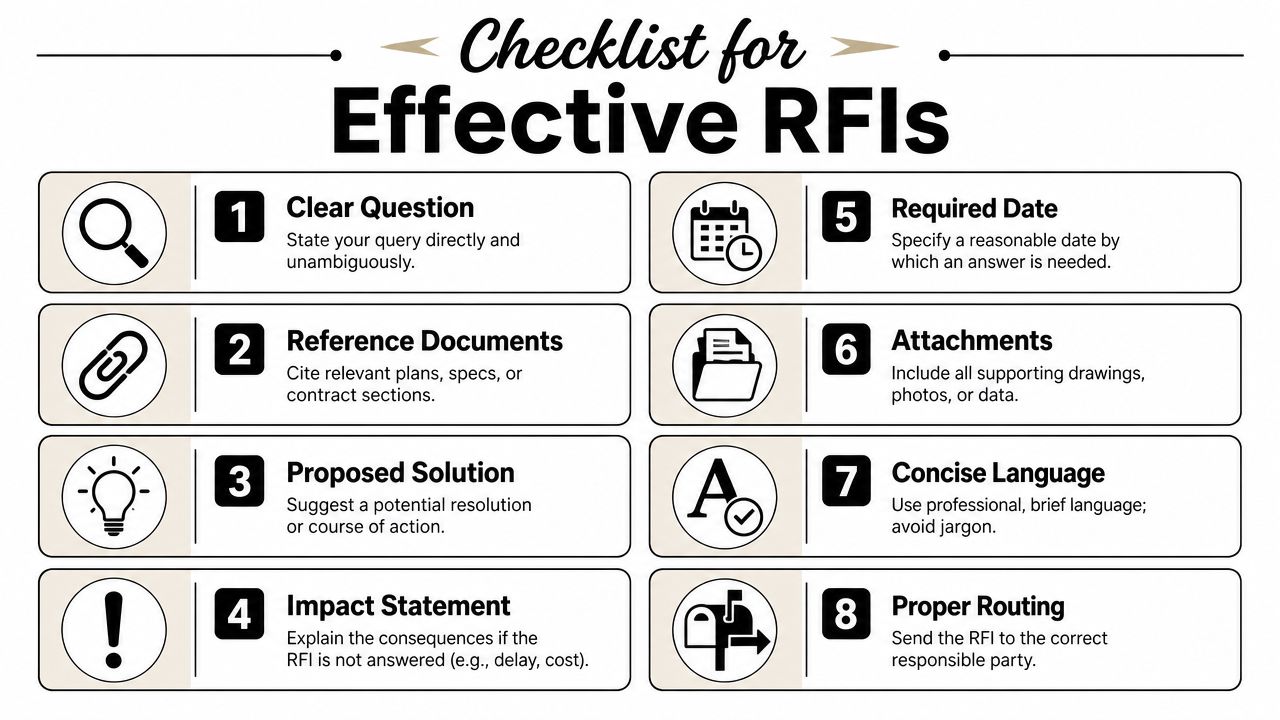
What to include every time
When I review draft RFIs from junior engineers, I'm looking for whether the recipient can answer the question without first doing detective work.
Use this checklist:
- Name the exact location. “Level 3 plantroom” is useful. “Services area” is not.
- Cite the exact reference. Drawing number, revision, detail bubble, grid line, or specification clause.
- State one clear question. If you have three unrelated issues, raise three RFIs.
- Explain the site impact. Say what work is being held, coordinated, or procured.
- Offer a proposed interpretation. Don't design around the consultant, but do give them a decision to confirm or reject.
- Attach evidence. Marked-up plans, photos, sketches, or coordination snapshots.
- Set a reasonable required date. Not every query is urgent. The critical ones are.
Field advice: The fastest RFI to answer is the one that already points to the likely resolution.
A simple sample
Here's a practical format that works.
Subject
RFI 023. Level 2 stair core. Conflict between structural opening and architectural wall setout
Question
Architectural drawing A-214 Rev C shows wall setout hard against gridline B. Structural drawing S-118 Rev B shows slab opening offset from gridline B. Please confirm the intended wall position relative to the slab opening.
References
A-214 Rev C, wall type W12 at grids B/4-5
S-118 Rev B, opening detail at grids B/4-5
Site impact
Framing subcontractor can't proceed with wall installation in this area without confirmed setout.
Proposed resolution
Proceed with wall setout to suit structural opening unless architectural revision issued otherwise.
Response required by
Insert project-specific due date.
That format works because it does the hard thinking before the RFI leaves your desk. It doesn't dump an unframed problem on the consultant. It presents a defined issue and gives them something precise to rule on.
Avoiding Common RFI Pitfalls and Delays
Most RFI delays aren't caused by the idea of RFIs. They're caused by poor habits. Teams create unnecessary churn, then blame the process.
The biggest trap is vagueness. “Please clarify” sounds harmless, but it's one of the worst phrases in construction administration. Clarify what, exactly? Against which document? At which location? For which trade package?
Bad habits that slow projects down
These are the ones that keep showing up:
Bundling unrelated questions
One RFI asks about steel, fire stopping, joinery, and ceiling coordination. Different consultants need to answer different parts. Nobody owns the whole response, so the item drifts.Using the RFI to vent frustration
If the wording reads like an argument, the response usually turns defensive. Keep the record factual.Raising RFIs too late
A team sees the issue during coordination, does nothing, then escalates it once labour and plant are already standing by. That turns a manageable query into a live delay.Sending to the wrong party
A services design issue lands with the architect, who then has to redirect it. Days disappear for no technical reason.Treating email as the register
Once responses live in inboxes, people start building from forwarded messages, partial screenshots, or outdated attachments.
What works instead
Good teams use a few simple controls.
First, keep each RFI to one issue wherever possible. If questions are linked, say so, but don't force multiple disciplines into one record unless their dependence is essential.
Second, strip the emotion out. Write the issue so that someone who wasn't in the meeting can understand it months later.
Third, raise the RFI when the issue is discovered, not when the delay has already hit the site. Early RFIs are easier to answer and easier to absorb into the programme.
A vague RFI wastes the responder's time first. Then it wastes everyone else's.
Finally, close the loop. An answered RFI isn't finished until the right drawings, markups, supervisors, and subcontractors are aligned to that answer. A neat register with poor field distribution still creates mistakes.
How Modern Platforms Streamline the RFI Process
The old RFI model was built around email chains, PDF attachments, and someone manually updating a register. That still exists on plenty of projects, and it still causes the same problems. Duplicate queries. Version confusion. Missed responses. Weak audit trails.
That's why the more useful question today isn't just what an RFI is. It's how teams manage RFIs across versioned PDFs, mobile field apps, and distributed consultants. That gap is increasingly obvious on Australian projects, especially where teams are trying to prevent duplicate RFIs, missed responses, and confusion across multiple drawings and consultants, as noted in this discussion of digital RFI challenges.
Why email and folders break down
Email works until the project gets busy. Then the same issue appears in three places:
- a superintendent's markup,
- a consultant reply in someone else's inbox,
- and a revised PDF in a folder that half the team hasn't opened.
At that point, the RFI stops being a controlled process and becomes a scavenger hunt.
Remote collaboration makes that worse. When architects, engineers, subcontractors, and field teams aren't all in the same office, weak document control gets exposed quickly. People answer against the wrong revision. Teams reopen resolved issues because they can't find the original decision. Similar questions get raised twice because nobody can see the history clearly.
What a better workflow looks like
A modern platform fixes this by connecting the RFI to the actual working record of the project.
The strongest setups usually include:
- Linked drawings and documents so the user can jump straight from the question to the affected sheet or reference.
- Version control so the team can see which revision the RFI was raised against and whether the response has been overtaken by a later issue.
- Structured workflows that show who has the item, who is waiting, and what is overdue.
- Centralised visibility so consultants, PMs, and site teams aren't relying on private inboxes to understand project status.
- Activity history that preserves the decision trail for QA, handover, and disputes.
- AI-assisted drafting and analysis that helps teams frame clearer questions, compare drawings, and follow cross-references faster.
The important point isn't the software by itself. It's the discipline the software supports. The best systems don't replace project judgment. They make good judgment easier to apply consistently, especially when the project is moving fast and multiple disciplines are touching the same issue.
If you're still handling RFIs through scattered emails and manually named PDFs, you're asking the team to solve a record-keeping problem before they can solve the technical one. That's backwards. The process should help people find the answer, trust the answer, and act on it without second-guessing which document is current.
If your team wants a cleaner way to manage RFIs alongside drawings, markups, approvals, and document revisions, take a look at Doclio. It gives project teams a single source of truth across design and delivery, with linked documents, structured workflows, real-time activity, and AI tools that make it easier to turn a site query into an auditable project record.