
You’re probably dealing with one of two situations right now. Either someone has handed you an ITP and it looks like a spreadsheet full of codes, initials and sign-off boxes, or you’re already on site and someone’s asking why the crew has to stop work for “another inspection”.
That’s where a lot of quality failures start. Not with a dramatic collapse, but with one missed check, one unclear acceptance criterion, or one subcontractor who thought the next step was safe to proceed. By the time the defect shows up, the work is buried behind concrete, cladding, waterproofing, services, or finishes. Then the project pays for it twice. Once to build it wrong, and again to tear it out and fix it.
If you want the plain-English answer to itp meaning in construction, it’s this. An ITP is the agreed quality control map for a scope of work. It tells the team what must be checked, when it must be checked, who signs it off, what standard applies, and what record proves the check happened.
Table of Contents
- Why a Simple Checklist Can Save a Multimillion-Dollar Project
- What Is an Inspection and Test Plan in Construction
- The Anatomy of a Standard ITP Document
- Hold Points vs Witness Points The Critical Difference
- The ITP Workflow From Creation to Field Sign-Off
- Best Practices for Ironclad ITP Management
- How Doclio Streamlines Your Entire ITP Process
Why a Simple Checklist Can Save a Multimillion-Dollar Project
A common site failure looks ordinary at first. Reinforcement is tied, formwork is up, the pour is booked, and everyone wants the slab done before weather or programme pressure shifts the sequence. Then one issue gets missed. Cover is off. Bars don’t match the drawing revision. Cast-in items aren’t where the services team needs them. Nobody picks it up until after the pour.
At that point, the argument starts. Was it inspected. Who approved it. Which drawing was live. Did the subcontractor call for inspection. Did the engineer attend. The concrete doesn’t care whose inbox the email was sitting in. If the check didn’t happen properly, the defect is already in the structure.
That’s why an Inspection Test Plan, usually shortened to ITP, matters. It isn’t paperwork for the sake of paperwork. It’s the control that forces the right people to stop, verify, record and release work at the moments where mistakes become expensive.
Where small misses become big claims
Waterproofing is another classic example. If the membrane prep, substrate condition, terminations, penetrations and flood testing aren’t checked in sequence, the defect often shows up much later. Then ceilings come down, finishes get damaged, and everyone spends weeks proving who did what.
An ITP reduces that ambiguity because it defines:
- What gets inspected before work is covered up
- Who is responsible for doing the work and who verifies it
- Which standard or drawing the inspection is measured against
- What evidence must be kept for later review
Practical rule: If a defect will be hidden by the next trade, it needs a clear inspection point before that next trade starts.
The value isn’t theoretical. A 2022 ACIF finding summarised in Procore’s guide to inspection and test plans reported that projects using formalised ITPs experienced 37% fewer defects at handover, with rework costs reduced by up to 15% on average for commercial builds over AUD 50 million.
What works on live projects
A simple checklist saves projects only when it’s used as an active control. The ITP has to sit in the workflow, not in a folder no one opens after the prestart meeting.
What usually fails is familiar:
- Generic ITP templates copied from another job with no link to the actual scope
- Acceptance criteria written vaguely, such as “as per standard”
- Late inspection calls, after the crew is already ready to pour, backfill or close up
- Missing records, where the team remembers the check but can’t prove it later
What works is stricter and more practical. The crew knows what the hold points are before work starts. The supervisor knows which drawing governs the check. The engineer knows when inspection is required. The evidence is captured immediately, not chased at the end of the month.
What Is an Inspection and Test Plan in Construction
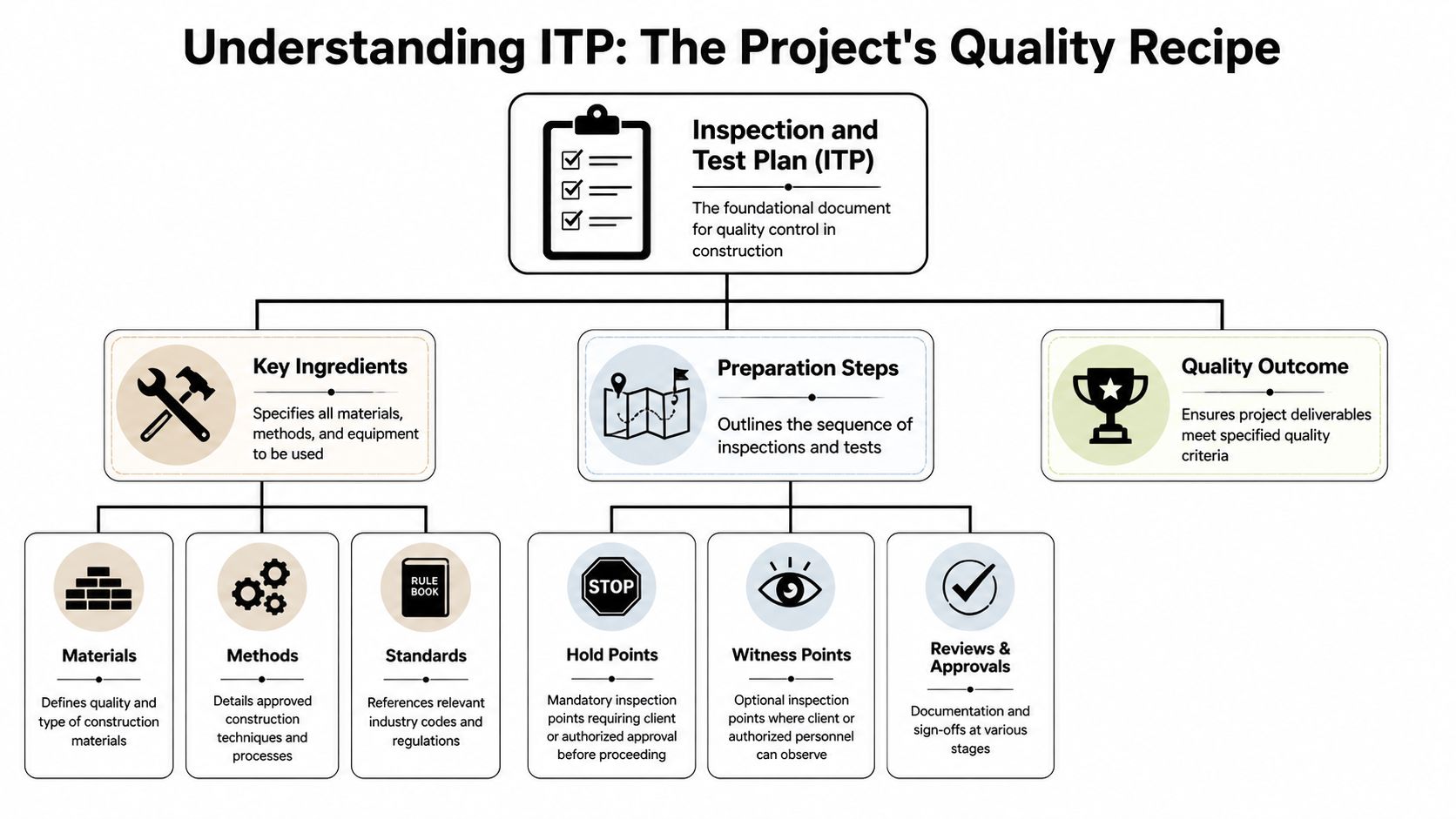
The most useful way to understand an ITP is to think of it as the project’s quality recipe. A recipe doesn’t just say “cook dinner”. It lists the ingredients, the sequence, the temperatures, the checkpoints, and what the finished result should look like. An ITP does the same for construction work.
In practical terms, an Inspection and Test Plan is a formal document that sets out the inspections, tests, review points and approvals required for a defined scope of work. It might apply to concrete, structural steel, firestopping, façade installation, civil works, services testing, or any package where quality has to be verified against drawings, specifications and contract requirements.
Why the document exists
The point of an ITP is simple. It creates one agreed method for proving that work meets the required standard before the job moves on.
That matters because construction quality breaks down when teams rely on assumptions. The subcontractor assumes the engineer will inspect. The engineer assumes the site team will call up the check. The builder assumes the test certificate will arrive later. The client assumes the record exists. An ITP replaces those assumptions with a defined process.
In Australian construction, ITPs are widely embedded in large project quality systems and are commonly used to align work with the National Construction Code, project specifications and state-based inspection obligations. They’re also a standard part of ISO 9001-compliant quality management systems, where consistency, traceability and sign-off matter across the life of the job.
What an ITP usually covers
A good ITP doesn’t try to describe everything about the build. It focuses on the parts that need verification.
Typical content includes:
- Work activities that need inspection or testing
- Inspection points such as hold points, witness points and review points
- Acceptance criteria tied to drawings, specifications or codes
- Responsible parties for performing, checking and approving
- Required records such as photos, test results, checklists and certificates
An ITP isn’t there to catch people out. It’s there to stop bad work getting buried, handed over, and argued about later.
Why juniors and subcontractors should care
If you’re a junior engineer, leading hand or subcontractor, the ITP tells you what “done properly” means before someone rejects your work. That’s why understanding itp meaning in construction is more than a compliance exercise. It protects your team from avoidable rework and protects the project from quality drift.
The strongest teams treat the ITP as a shared operating document. It gives the site supervisor clarity, gives the quality manager evidence, and gives the client confidence that critical checks happened at the right time.
The Anatomy of a Standard ITP Document
Most ITPs look more complicated than they are. Strip away the logos, revision boxes and approval signatures, and what you’re left with is a decision table. Each row asks the same question. For this part of the work, what needs to be checked before we proceed?
Once you read it that way, the form becomes easier to build and easier to use on site.
The columns that matter
Every standard ITP should identify the work step, the governing reference, the inspection type, the acceptance criteria, the responsible party and the record that proves compliance. If one of those pieces is missing, someone will fill the gap with assumption.
Here’s the structure commonly relied on:
| Component | Description | Example |
|---|---|---|
| Work activity | The specific task or stage being controlled | Rebar placement before concrete pour |
| Inspection or test | The check that must occur | Visual check, measurement, pressure test |
| Inspection point type | Whether the point is hold, witness, review or routine surveillance | Hold point before pour |
| Reference documents | Drawings, specifications, method statements or standards that govern the work | Structural drawing revision, project specification clause |
| Acceptance criteria | The measurable or observable requirement for passing the check | Bar size, spacing, cover and embedments match approved documents |
| Responsible party performing the work | The contractor or subcontractor carrying out the activity | Concrete subcontractor |
| Responsible party verifying the work | The person or organisation checking and approving | Site engineer, superintendent, client representative |
| Records | The evidence kept as proof | Signed checklist, photos, test certificate, inspection report |
| Status or sign-off | Confirmation that the step is complete and released | Accepted, rejected, pending rectification |
What junior teams often misunderstand
The most common mistake is treating the ITP as an admin template rather than a control plan. That leads to weak entries.
A poor entry says “inspect waterproofing to standard”. A usable entry says which area is being checked, which detail applies, who must inspect, what must be sighted, and what record closes the point.
Another failure is writing acceptance criteria that cannot be inspected. If the criterion says “installed correctly”, the inspector still has to guess what that means. If it says “installation matches approved detail and manufacturer requirements”, the team at least knows what to compare against.
Site advice: If an inspector can’t reject the work using the wording in the ITP, the wording is too vague.
The hidden value in the records column
The records column gets ignored until the project hits handover, a defect claim or a dispute. Then it becomes one of the most important parts of the entire document.
A record can be as simple as a signed checklist and geotagged photos, or as formal as a test certificate, engineer release, calibration evidence or commissioning sheet. What matters is that the project can prove the inspection happened, show what standard was applied, and identify who accepted the work.
That’s why experienced project managers push for disciplined records at the time of inspection. Recreating evidence later is slow, unreliable and often impossible.
A simple test for whether your ITP is strong
Read one row and ask four questions:
- Can the crew tell when to stop work for this check
- Can the inspector tell exactly what to inspect
- Can the approver tell what standard governs acceptance
- Can the project team find the evidence later
If the answer to any of those is no, the ITP row isn’t finished.
Hold Points vs Witness Points The Critical Difference
A significant amount of avoidable delay stems from this. Teams use hold points and witness points as if they’re interchangeable. They’re not. One stops the work until approval is given. The other gives someone the opportunity to attend, but the work can proceed if that person doesn’t show.
That difference affects programme, sequencing, inspection notices and risk.

What a hold point really means
A hold point is a mandatory stop. The contractor cannot continue until the required person inspects the work and formally releases it. If the crew proceeds anyway, they’ve bypassed the quality control system.
Pre-pour concrete inspections are a straightforward example. Once reinforcement, formwork, penetrations and cast-ins are in place, the pour shouldn’t happen until the hold point is cleared by the required parties. If that approval is missing, the risk sits with the team that continued.
Hold points suit activities where the next step will hide the work, lock in a structural or safety-critical condition, or create major rework if something is wrong.
What a witness point does differently
A witness point is less restrictive. The project notifies the relevant person that an inspection or test will occur, and that person may attend to witness it. If they don’t attend within the required notice period or release window, work can usually continue in line with the agreed process.
A sample bolt torque test is a good example. The inspector may want to observe the procedure, but the job doesn’t necessarily need to stop indefinitely if the test was properly scheduled and the inspector doesn’t appear.
This only works when the notice requirements are clear. If the contractor gives late notice, then claims the witness was missed, conflict follows quickly.
A hold point controls permission to proceed. A witness point controls the opportunity to observe.
Side-by-side comparison
| Point type | Can work continue without attendance | Typical use | Main risk if misused |
|---|---|---|---|
| Hold point | No | Hidden, irreversible or high-risk work | Unapproved work gets covered up |
| Witness point | Usually yes, if notice rules are met | Tests or inspections that benefit from observation | Teams assume attendance isn’t necessary and skip notice discipline |
A short explainer can help teams visualise the difference in practice.
Choosing the right one
Don’t make everything a hold point. That clogs the programme and frustrates the field team. But don’t downgrade critical checks to witness points just because the programme is tight.
Use a hold point when failure would be hard to detect later, dangerous to leave in place, or expensive to rectify once covered. Use a witness point when observation adds assurance, but the process can still continue if the notice protocol is met and the evidence is sound.
The ITP Workflow From Creation to Field Sign-Off
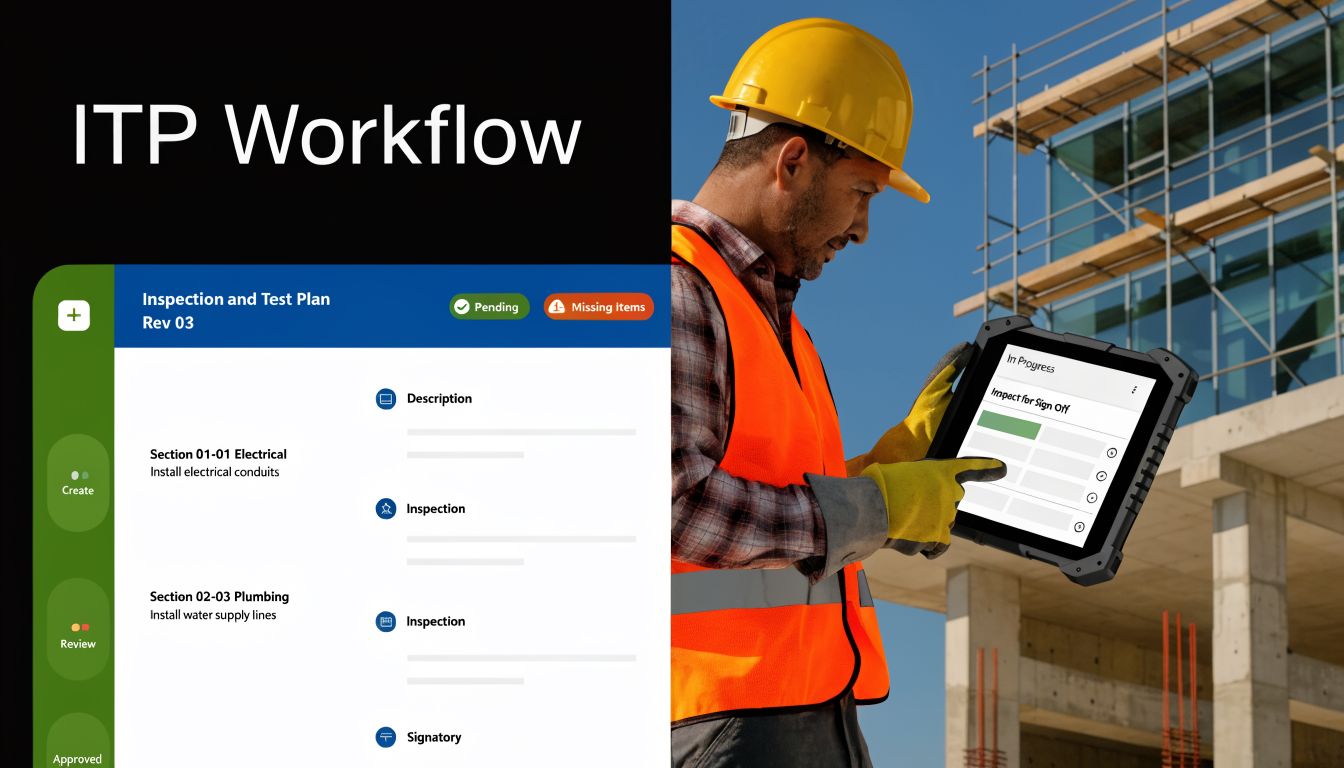
An ITP only works when the document moves cleanly from planning into live site execution. Too many projects write a solid ITP at the start, get the approvals, and then lose control once crews are in the field. The workflow matters as much as the wording.
On a well-run project, the ITP follows the work from drafting through to final record storage. Everyone knows where the current version sits, who can approve it, and how inspections are called up.
Step one through step three
The first part happens before site activity starts.
Drafting the ITP
The project engineer, QA manager or package engineer builds the ITP from the contract specifications, approved drawings, scope-specific method statements and applicable codes. Good drafters don’t work from memory. They cross-check every inspection point against actual project requirements.Internal review
The builder’s team reviews whether the ITP is practical. Can the inspections happen in the planned sequence. Are the hold points realistic. Are the responsible parties correct. Through this review, site knowledge prevents paperwork that looks neat but fails in the field.External approval
Depending on the contract, the ITP then goes to the client, superintendent, engineer or independent reviewer for acceptance. Work shouldn’t start on that controlled scope until the right approvals are in place.
Where field execution usually succeeds or fails
Once approved, the ITP has to reach the people doing the work. That means supervisors, foremen, subcontractor reps and inspectors need access to the live version, not a superseded PDF from an old email chain.
Field execution usually follows this pattern:
- The crew completes a work step and checks readiness for inspection
- The supervisor calls up the inspection in line with the notice period
- The inspector attends or reviews based on the point type
- Evidence is captured through photos, comments, marked drawings or test reports
- The point is signed off or rejected, with rectification raised if needed
The cleanest projects don’t wait until Friday to complete quality records for work done on Tuesday. They close each point while the evidence is still in front of them.
Final sign-off and archiving
The last part of the workflow is often under-managed. After sign-off, the record needs to be stored where the wider project team can retrieve it during handover, defect response or audit.
That means the project should retain:
- The approved ITP revision
- The completed inspection records
- Any linked test certificates
- Photos and marked-up evidence
- Closure records for defects or non-conformances
If those records sit across personal devices, inboxes and paper folders, the ITP has only done half its job. The inspection may have happened, but the proof becomes hard to trace when the project needs it most.
Why digital execution changes the result
Paper ITPs can work, but they depend heavily on individual discipline. Digital workflows improve the odds because they keep the latest version visible, reduce approval lag, and tie evidence directly to the inspection point.
That’s the shift many teams need to make. The ITP shouldn’t be a static file produced for compliance. It should be a live field control that the site team can use while the work is happening.
Best Practices for Ironclad ITP Management
Strong ITP management comes down to discipline in a few areas that teams often rush. When those basics are tight, quality improves. When they’re loose, the document becomes a form-filling exercise that doesn’t protect the job.
The commercial case is already strong. MBA data reported by VisiBuild indicates that ITP-adherent projects report 24% lower defect rates post-handover, with 92% achieving first-pass certification versus 71% without. The same source states that poor QA costs Australia AUD 15.3 billion yearly, and that ITPs can mitigate up to 30% of that through early issue detection.
Write for inspection, not for appearance
The best ITPs are precise enough that an inspector, foreman and subcontractor will all read the same row and reach the same conclusion about what has to happen.
Focus on these habits:
- Use clear acceptance criteria. Don’t write “to standard”. Write the actual condition the inspector is checking against the relevant drawing, specification or approved detail.
- Link each row to a real document. If the drawing revision changes, the ITP reference has to change with it.
- Assign named responsibility by role. “Contractor” is often too broad. The site needs to know whether the check sits with the installer, builder, engineer or third-party inspector.
Build the process before the work starts
Many quality problems aren’t technical. They’re timing problems. The ITP was approved late, the crew didn’t know a hold point applied, or the subcontractor assumed the builder would organise the inspection.
Practical controls help:
| Practice | Why it matters |
|---|---|
| Prestart review of ITP requirements | Stops field crews being surprised by hold points |
| Agreed notice periods for inspections | Prevents last-minute call-ups and site conflict |
| Training on evidence requirements | Improves records quality at the point of work |
| Routine audit of completed ITPs | Finds gaps before handover does |
One hard lesson: an ITP no one has explained to the site team is just a decorated spreadsheet.
Audit the weak spots, not just the paperwork
Some managers audit whether the form is signed. Better managers audit whether the control worked. They ask whether the right revision was used, whether the check happened before the next trade covered the work, and whether the attached evidence proves acceptance.
That mindset matters because signatures alone don’t protect the project. Traceability does. Timing does. Clear criteria do.
If you want ironclad management, push hardest on the risky interfaces. Below-ground services before backfill. Wet area prep before finishes. Structural steel before concealment. Fire and services penetrations before closure. Those are the points where good ITP practice pays for itself.
How Doclio Streamlines Your Entire ITP Process
Manual ITP management breaks down in predictable ways. The approved revision sits in one folder, the latest drawing sits somewhere else, site photos live on phones, and sign-off happens through emails that are hard to reconstruct later. Nobody intends to create confusion, but fragmented systems do it anyway.
That’s where a platform built for construction documents changes the day-to-day process. Instead of treating the ITP as an isolated form, the platform turns it into part of a connected project record.
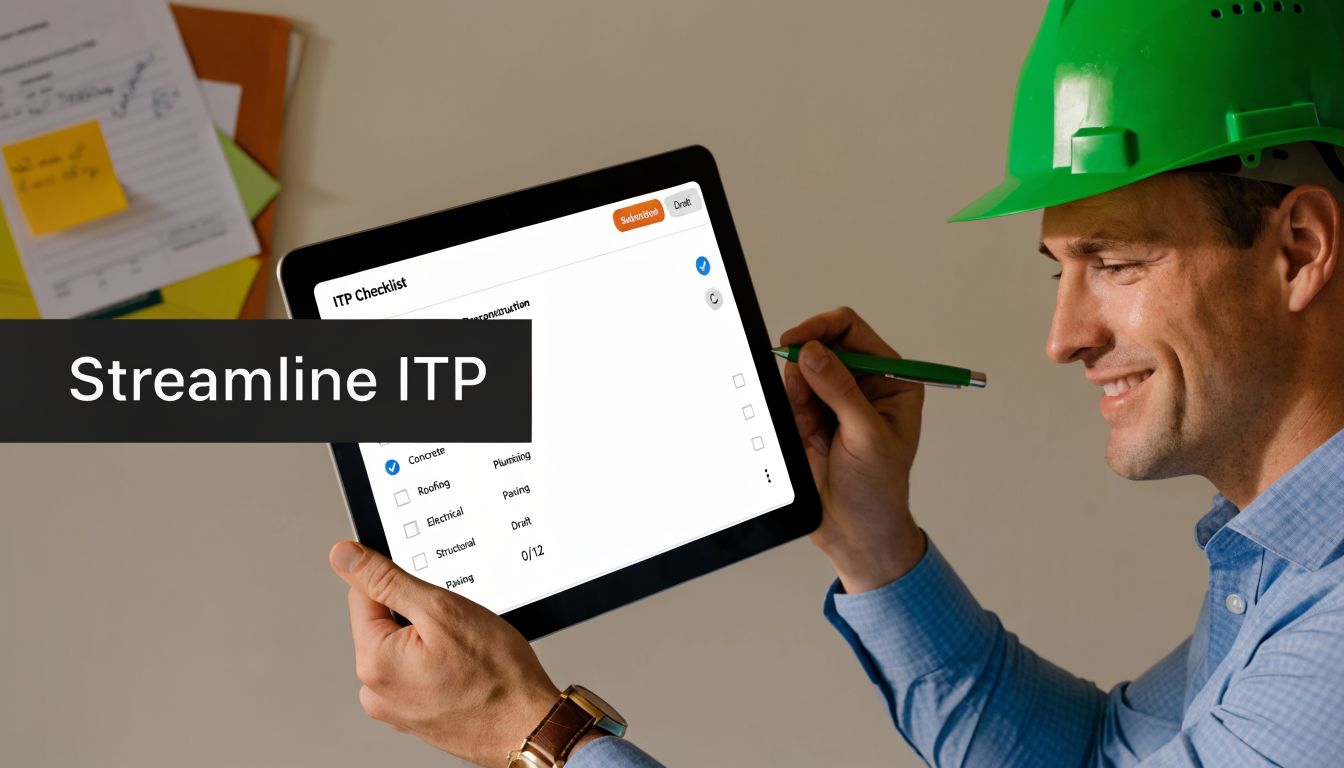
The biggest operational improvement is having a single source of truth. When drawings, specifications, approvals and field records live in one environment, the team spends less time checking whether they’re looking at the right file. That matters on fast-moving packages where a superseded reference can invalidate an inspection.
There’s also a practical advantage in smart linking. If an ITP item refers to a drawing detail or specification clause, teams shouldn’t have to dig through folders to find it. Being able to jump directly between the checklist item and the governing document cuts friction and reduces interpretation errors.
Where digital platforms help most
A good system improves the parts of ITP management that usually fail under pressure:
- Version control keeps teams from inspecting against outdated drawings
- Structured approvals replace loose email chains and verbal releases
- Markups and annotations let site staff show exactly what was checked or rejected
- Activity feeds create a visible trail of who reviewed, approved or requested changes
- Mobile access helps supervisors and subcontractors use the process in the field, not back at the site office
The strongest capability now is project-specific AI support. When an AI assistant can search project documents, compare drawings, and answer plain-language questions against actual project files, the ITP becomes easier to apply accurately. That helps junior staff confirm what a requirement means without guessing, and it helps managers verify whether the inspection record aligns with the documented requirement.
Used properly, digital tools shift the ITP from a compliance checkbox to a live coordination tool. That’s the significant gap many projects still need to close.
If your team wants tighter control over ITPs, drawings, approvals and field records in one place, take a look at Doclio. It gives project teams a single source of truth for construction documents, structured sign-offs, live collaboration, and AI-assisted answers against the actual project record, so quality checks are easier to run and much harder to lose.