An inspection and test plan is a formal quality control document that sets out the inspections, tests, and acceptance criteria for a specific scope of work. In practice, it works best when it's prepared before construction starts, so hold points, witness points, and evidence requirements are built into the job instead of chased after defects appear.
A lot of teams only pay attention to the inspection and test plan when a client asks for it, an auditor requests records, or a defect shows up at the worst possible time. By then, the ITP has already failed its real purpose. It has become paperwork after the event rather than a control before the work.
That's usually how rework gets embedded into a project. A pour goes ahead before reinforcement is properly checked. A service rough-in is covered before the right parties have inspected it. A trade installs to an old drawing revision because the ITP sitting in a folder doesn't match what's current on site. The failure isn't just technical. It's procedural.
An Inspection and Test Plan (ITP) is the document that prevents that slide into reactive quality management. It defines what must be inspected, how it will be tested, what standard applies, who is responsible, what records must be kept, and when work must stop for approval before proceeding. When it's done properly, it gives the site team a usable quality workflow. When it's done badly, it becomes a generic template that everyone signs and no one follows.
The gap I see most often isn't whether teams have ITPs. It's whether their ITPs are connected to the way the project runs. Paper forms, emailed spreadsheets, and uncontrolled revisions make a sound QA process hard to execute. A modern project team needs the discipline of a traditional ITP and the speed, traceability, and visibility of a digital workflow.
Table of Contents
- Introduction The Proactive Approach to Project Quality
- What Is an Inspection and Test Plan and Why Is It Critical
- Core Components of a Standard ITP
- Roles and Responsibilities in the ITP Process
- How to Develop and Implement an ITP
- Digitising ITPs with a Document Management Platform
- Frequently Asked Questions About ITPs
Introduction The Proactive Approach to Project Quality
A project can look healthy right up to the moment someone opens up finished work and finds a defect that should have been caught weeks earlier. One common example is concrete. The pour is complete, follow-on trades have moved in, and then a late review finds a mismatch between installed reinforcement and the approved detail. At that point, the issue is no longer a simple inspection item. It's a cost, programme, and trust problem.
That kind of failure rarely starts with one bad worker or one missed check. It starts when quality control is treated as scattered activity instead of a planned system. The site team relies on memory. The supervisor assumes the engineer saw it. The engineer assumes the subcontractor used the latest drawing. The client expects a record that doesn't exist. Everyone has touched the process, but no one controlled it.
A preventable problem
The reason experienced teams use an inspection and test plan is simple. Critical work needs predetermined checkpoints. If those checkpoints are only discussed informally, they get skipped under pressure.
Practical rule: If the work will be hidden, hard to reverse, safety-critical, or heavily specified, it needs a clearly defined inspection point before the next activity starts.
A usable ITP makes those checkpoints visible early. It forces the team to decide what must be checked, by whom, against which reference, and what evidence proves the check happened. That's how you stop defects before they become rework.
Quality control that lives in the programme
The strongest ITPs are not written to satisfy handover. They're written to control delivery. They sit alongside drawings, method statements, procurement planning, and inspection bookings.
That's also where many teams still struggle. They may have a technically sound ITP, but the live project runs on email chains, marked-up PDFs, whiteboards, and whatever spreadsheet the last person issued. The result is a quality process that exists on paper but not in real time.
A proactive approach means treating the inspection and test plan as an operating document. It should drive site actions, approvals, evidence capture, and revision control from the first activity through to completion.
What Is an Inspection and Test Plan and Why Is It Critical
An inspection and test plan is a formal document that defines the inspections, tests, acceptance criteria, compliance requirements, and reporting steps for a particular work activity or package. It isn't just a checklist. It's the document that turns drawings, specifications, standards, and contract requirements into a sequence of controllable quality actions.
Australian industry guidance describes ITPs as a standard part of construction quality management, commonly tied to compliance with the NCC and relevant AS/NZS standards. That same guidance notes that ITPs are typically prepared during project planning, before construction begins, so quality checkpoints and hold points are built into the schedule rather than added later. It also describes the ITP as a formal QA/QC roadmap used to verify work against contractual, regulatory, and technical references on Australian projects. You can see that framing in Procore's Australian guidance on inspection and test plans.
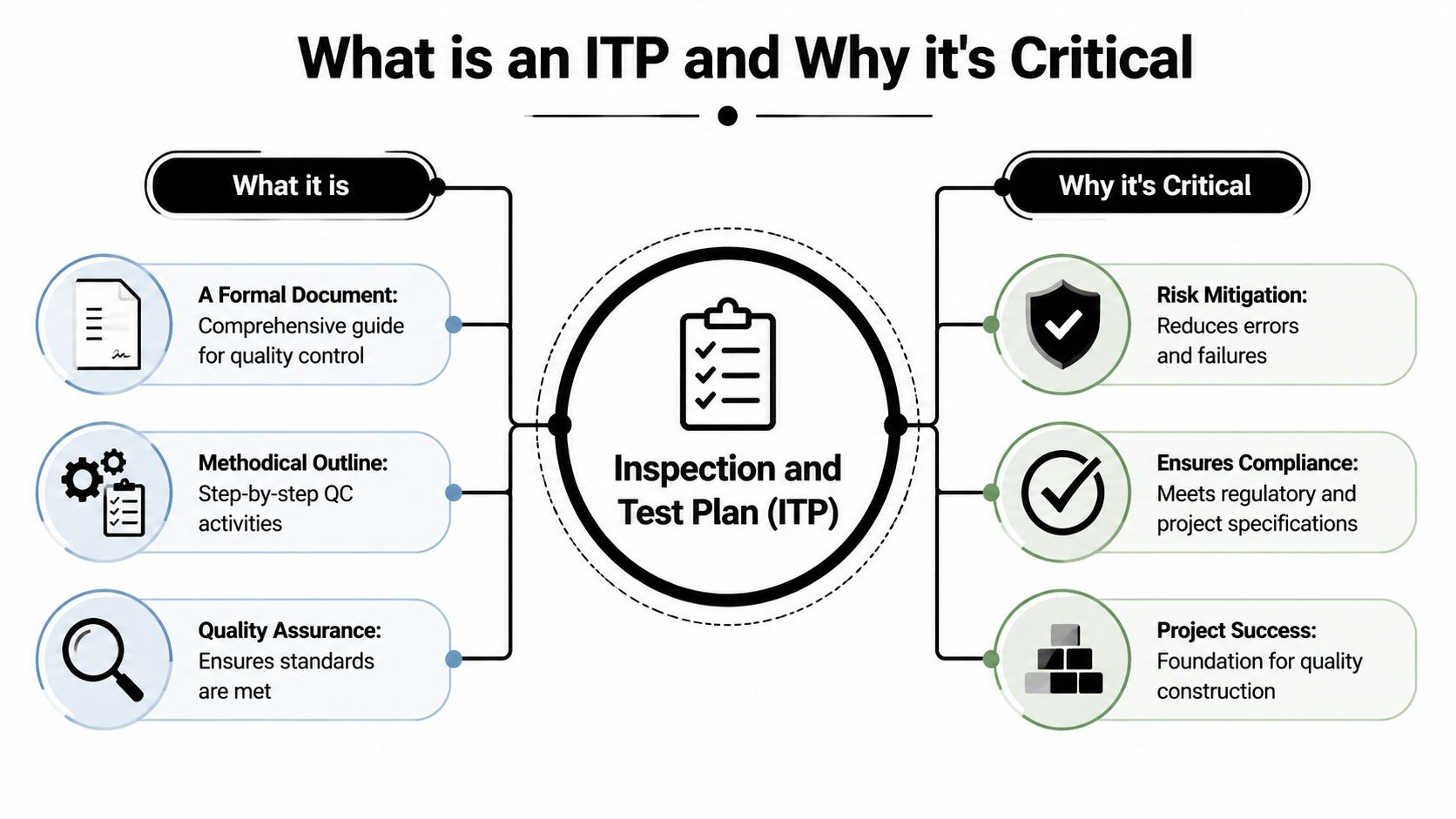
The document that turns specifications into action
Most specifications are not written for fast use in the field. They're necessary, but they're broad, layered, and often spread across multiple documents. An ITP takes that complexity and converts it into site-ready controls.
A good way to think about it is as a quality recipe for one scope of work. It identifies:
- What must be checked: materials, workmanship, dimensions, installation sequence, tests, or records
- What reference applies: drawings, specification clauses, code requirements, approved submissions
- What standard must be met: the acceptance criteria for passing or failing
- What happens next: sign-off, rework, retesting, or hold before proceeding
Without that translation step, teams often rely on broad assumptions such as “build to spec” or “inspect before cover-up”. Those aren't controls. They're intentions.
Why it matters on Australian projects
On Australian jobs, the ITP matters because it gives a traceable path from the work in the field back to the requirements that govern it. That includes contract obligations, project-specific technical requirements, and the compliance framework that sits around the work.
A strong ITP removes ambiguity. The crew knows what “acceptable” means before the task starts, not after someone rejects the work.
It also creates discipline at the right point in time. If the inspection point is built into planning, site teams can coordinate labour, subcontractors, testing agencies, and client representatives before the work reaches a no-return stage.
The practical value is straightforward. An ITP helps prevent hidden defects, supports handover records, and gives the project a defensible audit trail when questions arise later. That's why the document is critical. It gives quality control a structure that people can execute.
Core Components of a Standard ITP
A standard ITP only works if the information inside it is precise enough to control the activity. Generic wording is one of the fastest ways to make the document useless. If a line item says “inspect installation” without identifying the stage, standard, responsible party, and evidence required, the team will interpret it differently every time.
Australian QA/QC guidance emphasises that ITPs are designed to avoid 100% inspection in most cases. Instead, they use defined testing frequencies and sampling processes, and they capture what is to be inspected or tested, by whom, at what stage or frequency, with hold and witness points, relevant standards, acceptance criteria, and records to retain. That structure is outlined in this QA/QC overview of inspection and test plans.
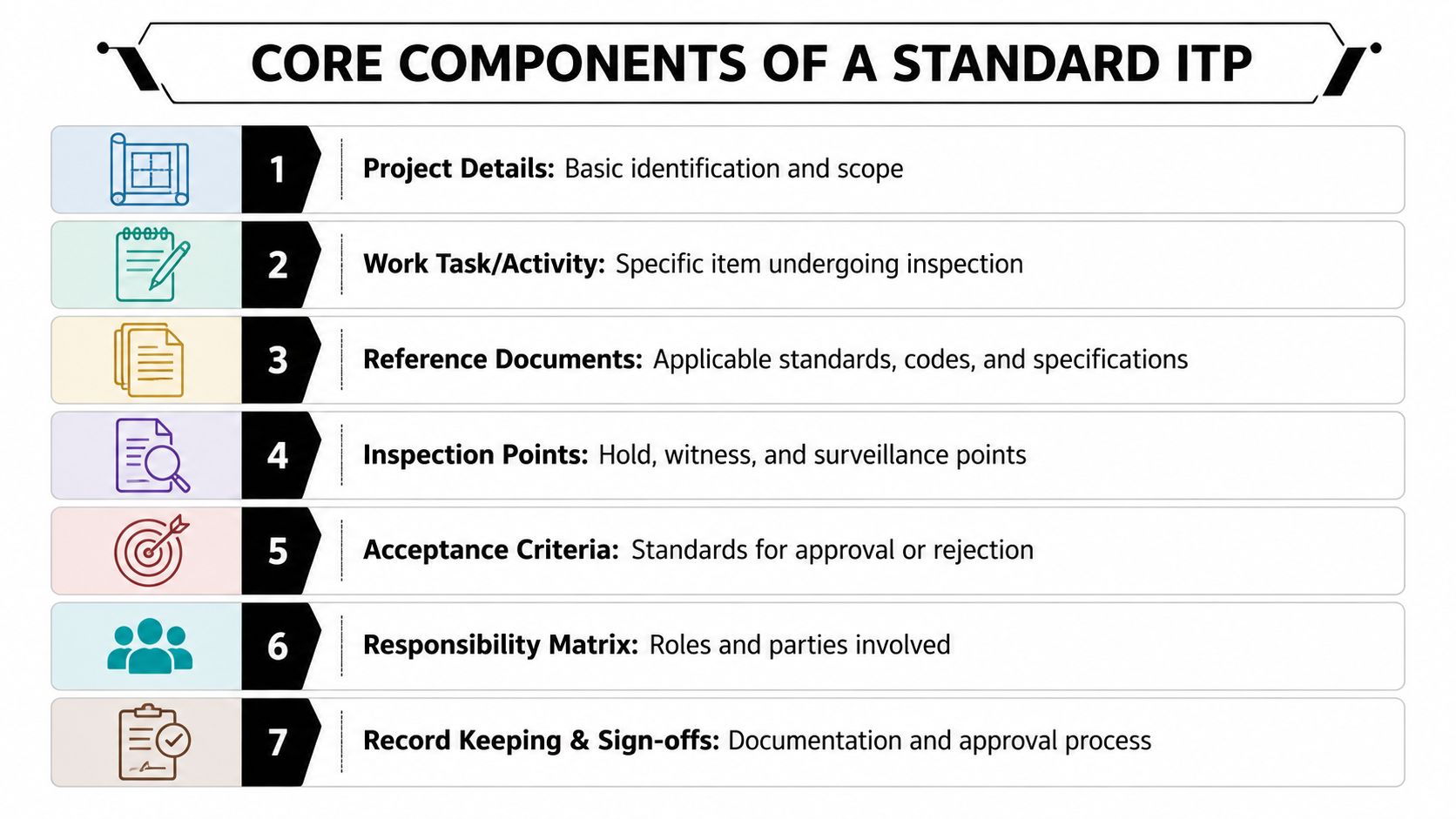
The fields that make an ITP usable
Most workable ITPs contain a structured matrix. The exact template varies by contractor or client, but the core fields should do the following job:
| Component | Purpose |
|---|---|
| Project details | Identifies project, package, location, revision, and scope |
| Activity or task | States the exact work item being controlled |
| Reference documents | Links the task to drawings, specifications, codes, or approved procedures |
| Inspection or test requirement | Describes what must be checked or tested |
| Stage or frequency | States when the check occurs, or how often sampling is required |
| Acceptance criteria | Defines the condition for approval |
| Responsibility | Names who performs, witnesses, reviews, or approves |
| Record | Identifies what evidence must be retained |
The reference document field matters more than many teams realise. If it's vague, the inspector can't reliably judge compliance. “As per drawings” is weak. Specific drawing numbers, specification clauses, approved shop drawings, and material submittals make the line enforceable.
The acceptance criteria field is where quality becomes objective. It should state what pass looks like in a way the person inspecting can verify.
Hold witness and surveillance points
These intervention points are where the inspection and test plan stops being a passive document and starts controlling work.
- Hold point means the work cannot proceed until the required inspection or approval has occurred.
- Witness point means the nominated party has the opportunity to observe the inspection, but work may continue if they do not attend in accordance with the agreed process.
- Surveillance point is a monitoring check. It's used for oversight without stopping the work sequence every time.
Site advice: Reserve hold points for work that becomes concealed, difficult to rectify, or contractually sensitive. If everything is a hold point, nothing is prioritised and the programme starts fighting the quality system.
Another key trade-off is detail versus usability. Some ITPs collapse because they try to capture every microscopic step. Others fail because they're too broad. The right balance is to make each line item meaningful at the field level. If a supervisor can't look at the row and know exactly what has to happen next, the line is too vague.
Roles and Responsibilities in the ITP Process
An inspection and test plan doesn't fail because the template is poor. It usually fails because ownership is blurry. If no one knows who must raise the inspection request, who checks the latest revision, who attends the hold point, or who files the evidence, the process turns into a chain of assumptions.
Who owns the document and who owns the work
The subcontractor or trade contractor usually knows the work package in the most practical detail, so they're often best placed to draft the first version of the ITP for their scope. That draft should reflect the actual sequence of work, the references they're building to, and the inspections that are realistic on site.
The contractor's quality manager or project quality lead then reviews it for consistency with project requirements. That review should check scope coverage, document references, hold and witness points, record requirements, and alignment with the broader project controls.
The site engineer or supervisor is often where the ITP becomes real. They coordinate execution in the field. They confirm that inspections are called up at the right time, that work isn't pushed past required checkpoints, and that the records match what happened.
Other common parties include:
- Third-party inspectors: specialist testing, certification, or independent verification
- Client or superintendent representatives: review or sign-off at nominated stages
- Design consultants: technical review when compliance depends on design intent or approval of specific details
Where accountability usually breaks down
The most common failure is not that someone refuses to do their job. It's that one task sits between roles. The subcontractor thinks the builder will book the witness inspection. The builder assumes the quality team has already approved the revision. The client arrives with comments after the work has moved on.
That's why the ITP should identify not just responsible parties, but the action expected from each one.
A practical handover of responsibility usually looks like this:
- The trade drafts the activity-specific ITP.
- The contractor reviews and approves it for use.
- The field team executes work to the current revision.
- The required inspection is requested before the checkpoint is passed.
- Evidence and sign-off are captured and stored against the activity.
If any one of those steps is informal, the system weakens quickly.
How to Develop and Implement an ITP
The fastest way to produce a bad inspection and test plan is to start with an old template and change the title block. That approach gives you a document, but not a control. A useful ITP starts with the actual work package, the actual risks, and the actual references the team will use on site.
A practical development sequence
Start by breaking the project into work packages that need their own quality controls. Structural concrete, waterproofing, facade installation, in-ground services, fire stopping, and commissioning all need different inspection logic.
Then gather the documents that define the work. That usually includes drawings, specifications, approved submittals, methodologies, client requirements, and any nominated codes or standards relevant to the package.
Build the matrix from the work sequence, not from a filing system. If the work happens in five practical stages, the ITP should follow those stages.
A workable process looks like this:
Define the scope clearly
Write the ITP for one activity or package only. Mixed scopes create confusion.List the critical steps in order Use the site sequence. Include pre-installation checks, in-process checks, and completion checks.
Attach the correct references
Tie every inspection step to the documents that govern it.Set acceptance criteria
Avoid broad wording like “to specification”. State what the inspector must confirm.Assign intervention points
Mark where work must stop, where attendance is invited, and where surveillance applies.Nominate responsibility and records
State who performs the inspection, who approves it, and what evidence stays on file.
If a line item can't be understood by the person standing in front of the work, rewrite it before issuing the ITP.
Sample ITP for concrete footing installation
Below is a simple example format. It's not a universal template, but it shows how the logic should work.
| Activity No. | Activity Description | Reference Document | Inspection Type (H/W/S) | Acceptance Criteria | Responsible | Record |
|---|---|---|---|---|---|---|
| 1 | Review approved drawings and footing set-out | IFC structural drawings, survey information | S | Set-out matches approved location and dimensions | Site engineer | Survey check record |
| 2 | Verify excavation depth and founding condition | Geotechnical requirements, drawings | W | Excavation conforms to required depth and condition for footing | Site engineer, consultant if required | Inspection record |
| 3 | Inspect formwork installation | Formwork drawings, project specification | S | Formwork size, line, level, and stability comply with approved requirements | Supervisor | Pre-pour checklist |
| 4 | Inspect reinforcement before pour | Structural drawings, bar schedule | H | Reinforcement type, placement, cover, laps, and fixing comply with approved details | Engineer, quality representative | Reinforcement inspection record |
| 5 | Confirm embedded items and penetrations | Coordinated drawings, approved shop drawings | H | All embeds and penetrations are in correct position before concrete placement | Engineer, relevant trade | Embed verification record |
| 6 | Witness concrete delivery and placement checks | Concrete specification, delivery documentation | W | Delivered concrete matches approved mix and placement requirements | Supervisor, testing representative | Delivery dockets, field record |
| 7 | Check curing and protection after pour | Project specification, method statement | S | Concrete is protected and cured in accordance with approved method | Supervisor | Curing record |
What works on site and what does not
What works is simplicity with discipline. Keep the activity descriptions plain. Use references people can locate. Make hold points visible enough that the programme team can plan around them.
What doesn't work is copying generic language from a library, setting too many hold points, or waiting until the work has started to agree the inspection process. Another weak habit is separating the ITP from the evidence. When records live in inboxes, phones, and scattered folders, close-out becomes slow and disputes become easier.
A strong implementation routine includes short pre-start reviews with the trade, confirmation that the latest revision is in use, and immediate capture of inspection evidence at the point of work.
Digitising ITPs with a Document Management Platform
Friday afternoon, the pour is booked for first light, and the team is still arguing over which ITP revision is current. One inspector has photos on a phone, the engineer has comments in email, and the supervisor is waiting on a hold point release that no one can clearly track. By that stage, the problem is not the inspection logic. It is control of information.
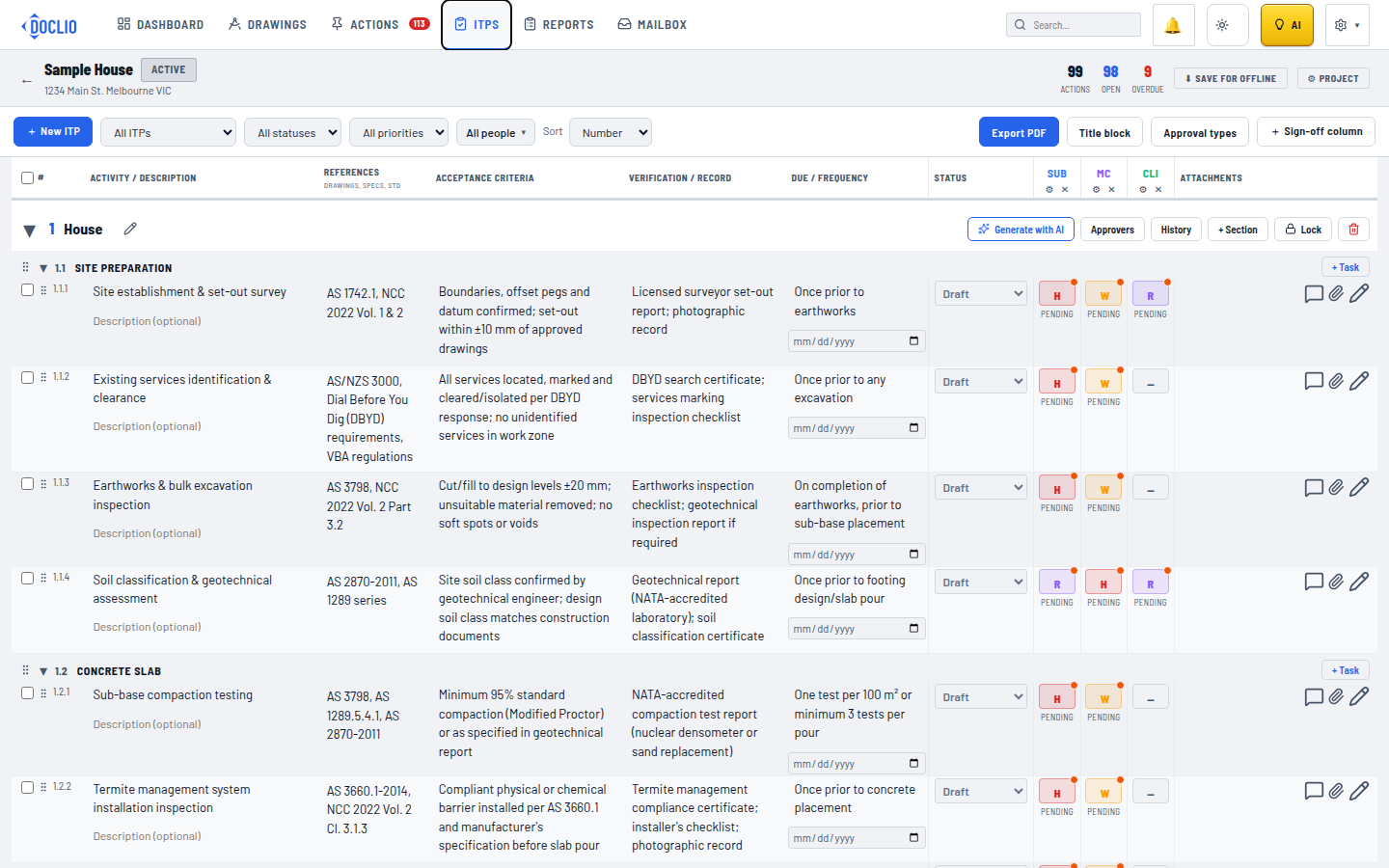
Why spreadsheets and email create quality risk
Spreadsheets and email can carry an ITP on a small, stable job. On a live project with design updates, multiple trades, and consultant reviews, they start to fail in predictable ways.
The common breakdowns are operational:
- Version confusion: site teams, subcontractors, and reviewers are not working from the same revision
- Evidence gaps: photos, dockets, checklists, and sign-offs sit in separate folders or inboxes
- Approval delays: inspections stall while records are printed, signed, scanned, and resent
- Poor traceability: it takes too long to confirm who approved a hold point, when they approved it, and which drawing revision applied at the time
That is when quality teams get dragged into administration instead of prevention. Defects are harder to stop early, and close-out turns into a record-hunting exercise.
What a digital workflow needs to do on a real project
A document management platform should remove friction from the control points that usually fail under pressure. It should keep the current revision visible, route approvals in a controlled sequence, give site teams mobile access, and attach evidence to the exact inspection item being reviewed.
Used properly, Doclio supports that approach by centralising drawings and documents, controlling revisions, allowing markups and pin annotations, routing approvals, and sharing records across internal and external project parties. In practice, that helps teams tie the inspection step to the live drawing set, capture photos and comments at the workface, and keep a clear approval trail without relying on scattered emails.
The value is not just speed. It is confidence in the record.
When an NCR, delay claim, or consultant query lands weeks later, the team needs more than a signed form. They need to see the approved document revision, the inspection evidence, the status of the hold or witness point, and the timing of each action in one place. A platform-based workflow gives that visibility far more reliably than a mix of spreadsheets, PDFs, inboxes, and shared drives.
Real-time collaboration also changes the way the project runs day to day. A supervisor can submit an inspection from the field, the quality lead can review it straight away, the consultant can respond to the release, and the project manager can see what is pending without asking someone to update a separate register. That matters on fast-moving work fronts where a missed approval can waste a crew, a pump booking, or a crane slot.
Digital ITPs do not replace discipline. They make disciplined quality control easier to maintain when revision cycles tighten, evidence volumes grow, and more parties need to act on the same record at the same time.
Frequently Asked Questions About ITPs
What is the difference between a project quality plan and an ITP
A project quality plan sits at the system level. It describes how the project will manage quality overall, including procedures, responsibilities, controls, document management, and assurance processes.
An inspection and test plan sits at the activity level. It controls one package or work scope by defining the inspections, tests, acceptance criteria, and records needed for that work. The project quality plan sets the rules. The ITP applies them to a specific task.
Who usually writes the ITP and who approves it
The party performing the work usually drafts the ITP because they understand the sequence, plant, materials, and practical inspection stages in detail. On many projects, that means the subcontractor or trade contractor prepares the first draft.
Approval usually sits with the head contractor's quality or engineering function, with review from the client, superintendent, or consultant where the contract requires it. The key point is that authorship and approval shouldn't be assumed. They should be defined in the project's quality process before work starts.
What happens when the scope design or method changes
If the drawing revision changes, the specification changes, the installation sequence changes, or a hold point needs to move, the ITP should be formally revised and reissued under document control. Don't mark up an old copy and rely on verbal advice.
A sound revision process includes:
- Reviewing the trigger: identify what changed and whether the existing inspection logic still works
- Updating the references: revise drawings, specifications, or procedures in the ITP
- Re-approving the document: send the revised ITP through the same approval path required by the project
- Withdrawing superseded versions: remove old copies from active use on site
- Briefing the field team: make sure the people doing the work understand the change before the next inspection point
The risk isn't just having an outdated form. The risk is carrying out correct work under the wrong control document, then struggling to prove compliance later.
If your team is still managing inspection and test plans across spreadsheets, email chains, and disconnected site records, it's worth looking at how Doclio can centralise drawings, approvals, and field evidence in one controlled workflow. For projects that need tighter document control and clearer visibility over inspections, that kind of setup can make the ITP a live delivery tool instead of a handover admin task.