You’re usually not thinking about as built drawings when the slab pour is under pressure, the services coordination meeting has blown out, and the client wants a revised programme by lunch. But six months after handover, when someone can’t work out where a rerouted pipe went, those drawings suddenly become the most valuable record on the job.
That’s the trap junior PMs fall into. They treat as-builts as a closeout chore. In practice, they’re a risk document, a payment document, a compliance document, and if you hand them over properly, an operations asset that keeps paying back long after the project team has left site.
Table of Contents
- What Are As Built Drawings Really
- The Anatomy of a Compliant Australian As Built
- The As Built Workflow From Red Lines to Real Time
- Best Practices for Flawless As Built Delivery
- From Project Handover to Operational Asset
- Adopting an As Built First Mentality
What Are As Built Drawings Really
Design drawings tell the team what was intended. As built drawings record what was constructed.
A simple way to think about it is this. The design set is the recipe. The as-built set is the finished meal, with every substitution, every adjustment, and every last-minute change written down so the next person knows exactly what ended up on the plate. If the design said one route and site conditions forced another, the as-built is where that truth belongs.
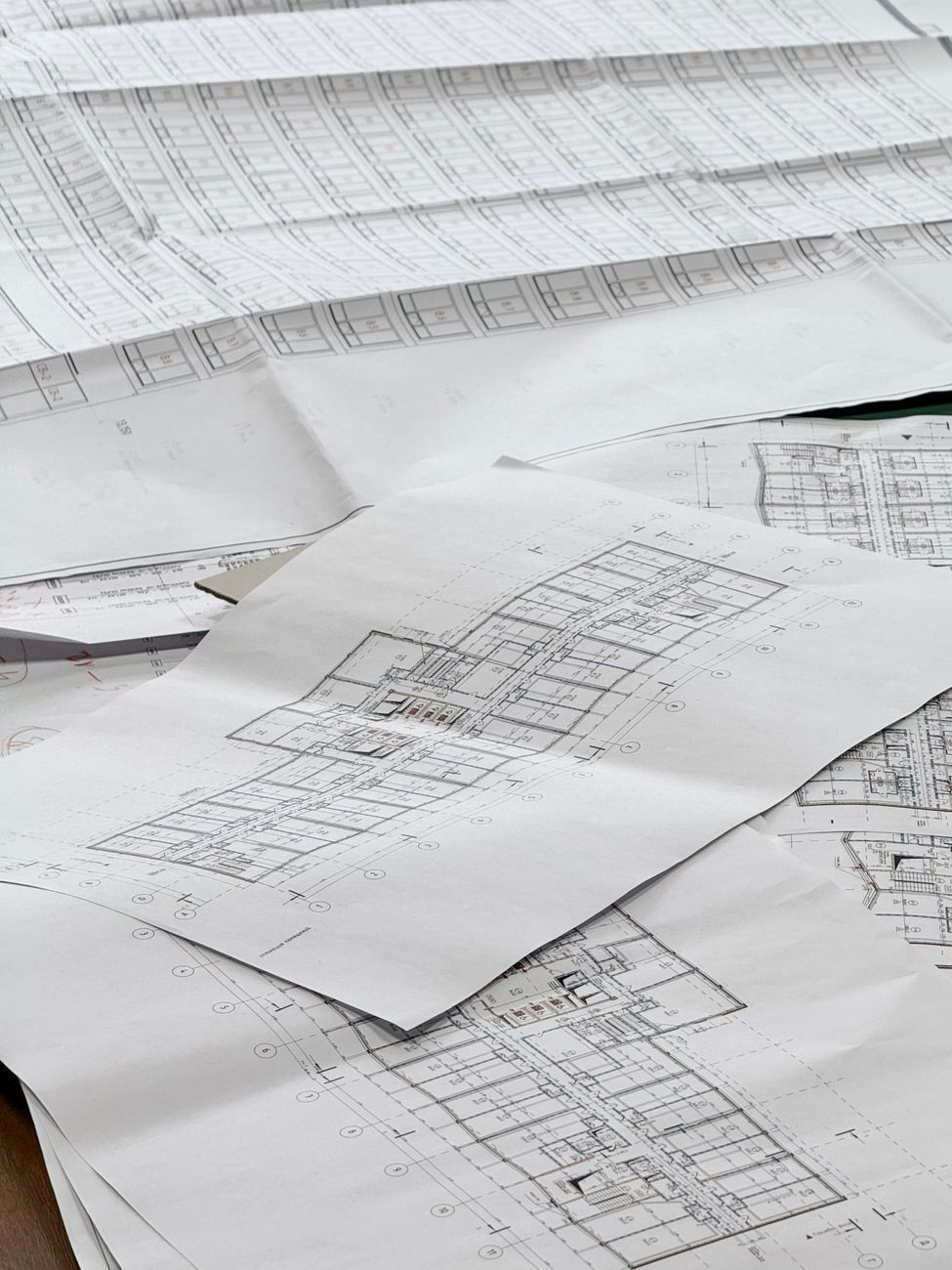
That’s why good as-builts aren’t “nice to have” paperwork. They’re the final record a builder, superintendent, consultant, owner, and facility team rely on when the original site conversations are long gone.
Why they matter beyond project closeout
The first reason is legal clarity. When a dispute starts over whether something was built as directed, an accurate as-built can settle the argument far faster than memory, emails, or marked-up paper copies. As noted in this discussion of how as-builts support dispute resolution, sources regularly point out that as-builts help resolve disputes by showing exactly what was constructed. For Australian projects, where defect liability and compliance are strict, a verifiable record can be the deciding factor in change order disputes and may save tens of thousands of dollars in legal fees and rectification costs on a single job.
The second reason is practical. Buildings don’t stop changing at practical completion. Tenants churn, plant gets replaced, access routes shift, and maintenance teams need to know what sits behind ceilings, below slabs, and inside risers. If the as-built set is poor, every future alteration starts with re-discovery.
Practical rule: If a future contractor has to guess what was installed, the project didn’t finish with a proper record.
What as-builts are not
They are not a lightly edited IFC set.
They are not a pile of subcontractor markups dumped into a handover folder.
They are not compliant just because someone stamped “as built” on the cover sheet.
A proper set should reflect field conditions, approved changes, relevant references, and enough detail that another competent person can use it without calling the original project team. That last part matters more than many PMs realise. If the document only makes sense to the people who built it, it has failed as a record.
A lot of teams learn this too late. They spend serious effort creating the deliverable because the contract requires it, then hand over something the facility manager can’t search, can’t trust, or can’t interpret without specialist help. That’s wasted effort. The true return comes when the same record helps the owner operate, maintain, and modify the asset without starting from zero.
The Anatomy of a Compliant Australian As Built
In Australia, compliance is not just about neat drafting. It’s about whether the record stands up to regulatory, technical, and contractual scrutiny.
Under the NSW Design and Building Practitioners Act 2020, as-built documentation is mandated on relevant projects, with associated requirements enforced by SafeWork NSW and Fair Trading NSW. For site grading and drainage, compliance requires survey-certified elevations accurate to ±10mm to meet AS 3798-2007, and inaccurate or uncertified as-builts can lead to 30-50% higher rectification costs during the defects liability period, according to the verified material provided in this Australian as-built requirements reference.
That tells you something important. A compliant as-built isn’t just a drafting output. It’s evidence.
What compliance actually means on site
The PM’s job is to make sure the record matches the work that was built, not the work that was expected. On site, that usually means checking four things before the package gets anywhere near handover:
- Dimensional accuracy: Critical levels, offsets, penetrations, set-outs, and service locations have to match verified field conditions.
- Approved change traceability: Variations, RFIs, site instructions, and redesigns need to connect back to the drawing record.
- Discipline coordination: Civil, structural, architectural, hydraulic, mechanical, and electrical records can’t contradict each other.
- Certifiable formats: The record needs to be issued in formats the owner, consultants, and legal teams can readily use later, such as DWG or PDF/A-3 where required for legal admissibility in disputes under the verified material.
What a good drawing set must capture
The best way to review an as-built package is to stop asking, “Did we upload all the files?” and start asking, “Could someone rely on this in five years?”
That means the set should capture:
- Field changes to geometry and location: If the duct, drain, cable tray, or footing moved, the drawing must show where it landed.
- Material and product changes: Substitutions matter, especially where maintenance, replacement, or fire and compliance obligations sit downstream.
- Installation notes linked to real events: Dates, trade changes, inspection-driven amendments, and references to related documents matter because they explain why the change exists.
- Concealed works detail: If the item disappears behind finishes, the record becomes far more important.
- Survey and sign-off status: Where survey certification or licensed sign-off is required, that should be obvious in the package.
A compliant record doesn’t just tell you where something is. It tells you why it differs from design and whether that difference was properly controlled.
Here’s a practical checklist I’d expect a PM to use before calling the package complete.
| Component | Verification Point | Format Standard |
|---|---|---|
| Architectural layouts | All field changes, dimensions, penetrations, and relocated elements reflected | PDF/A-3 and, where required, DWG |
| Civil grading and drainage | Survey-certified elevations verified to ±10mm against required tolerances | Certified survey output with PDF/A-3 and supporting CAD where applicable |
| Structural elements | Beam and column offsets, openings, embeds, and load-bearing revisions clearly marked | DWG and PDF/A-3 |
| MEP services | Final routes, equipment locations, access zones, and clashes resolved in the record | A3 PDF with embedded metadata for closeout workflows |
| Change references | RFIs, variations, site instructions, and approved red-lines cross-referenced | Hyperlinked or clearly indexed PDF set |
| Handover metadata | Revision status, discipline tags, dates, and sign-off clearly embedded | PDF/A-3 with searchable metadata |
If you want a simple test, ask a facility manager to open the package and find one piece of plant, one underground service, and one approved change. If that takes too long, the package may be contractually delivered, but it’s not operationally useful.
The As Built Workflow From Red Lines to Real Time
Most as-built problems don’t start at handover. They start the first time a site change gets written on paper and never properly carried through.
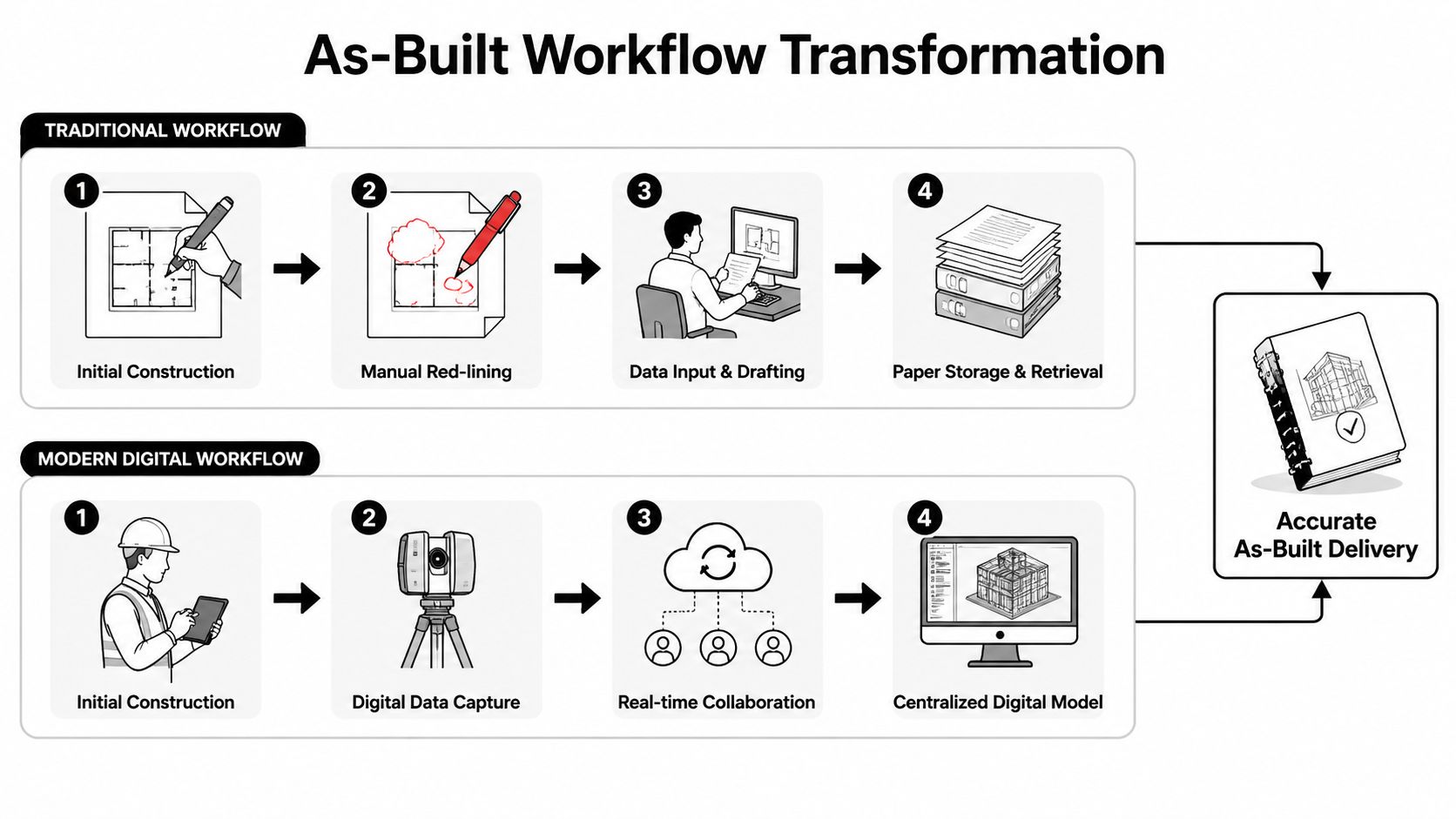
Traditional workflows still rely on marked-up hard copies, scattered emails, subcontractor sketches, and a late drafting effort in the final weeks of the job. That system can limp along on simple projects. On a live capital works project with constant MEP coordination, it breaks down fast.
Where the old workflow breaks down
The old method usually looks familiar.
A foreman marks up a printed drawing. Someone takes a photo of it. A coordinator types part of it into another document. The drafter updates a base file later. Another trade makes a conflicting change in the meantime. By closeout, everyone is trying to reconcile versions they no longer trust.
The failure points are predictable:
Changes are captured late
If the markup happens after the work is covered up, accuracy depends on memory. Memory is not a quality system.Ownership is blurred
The subcontractor thinks the builder is updating the record. The builder thinks the consultant will tidy it at the end. Nobody owns the live truth.Version control slips
Teams end up with multiple drawing copies in email chains, desktop folders, and site offices, each with different notes.Cross-references go missing
A field change may relate to an RFI, a variation, and a site instruction. If those links aren’t kept together, the drawing loses context.
The worst as-built workflow is the one that depends on one person remembering everything at the end of the job.
What the digital workflow fixes
A modern workflow changes the timing and structure of the work. Instead of treating as-built production as an end-stage drafting task, it treats it as continuous record-keeping through delivery.
That approach works better because each change moves through a controlled chain:
- Capture on site: Mark up the change when the work happens, not weeks later.
- Attach evidence: Add photos, notes, and references while the team still has direct visibility.
- Review in one environment: Project engineers, services coordinators, and consultants should review against the same current set.
- Approve and lock revisions: Once the update is accepted, the new record should be versioned and traceable.
- Export for handover in a clean structure: Operations teams need a package that’s searchable and logically grouped, not a digital skip bin.
There’s another benefit that younger PMs often overlook. Real-time workflows improve accountability without creating extra meetings. If every markup, review, and approval leaves an audit trail, you spend less time arguing about what was issued and more time fixing the actual issue.
The stronger digital setups also support drawing comparison, smart linking between referenced sheets, and structured approvals. That matters because most as-built errors aren’t dramatic drafting mistakes. They’re small omissions. A missed penetration. A rerouted branch line not reflected on one discipline sheet. A detail reference that still points to superseded information. Systems that surface those inconsistencies early save pain later.
The workflow that holds up under pressure
A practical workflow for PMs is simple:
- Site team captures field changes daily.
- Each trade updates its own red-lines under a defined responsibility matrix.
- The builder reviews package quality at agreed intervals, not just at the end.
- Consultants verify where design intent, certification, or regulated elements are affected.
- Surveyors sign off measurable elements that require certified accuracy.
- Final handover follows the same file logic used during delivery.
That last point is where many teams fail. They run the project one way, then dump handover documents in a completely different structure. Facility teams inherit confusion on day one.
Best Practices for Flawless As Built Delivery
Good as-built delivery is mostly process discipline. Software helps, scanners help, and strong drafters help, but none of those fix a team that waits until closeout to get serious.
The better approach is boring in the right way. It builds record-keeping into normal delivery so the final package is the result of steady control, not a last-minute salvage operation.
Capture during construction, not after it
If the team only updates as-built information when practical completion is approaching, accuracy drops and stress rises. What works is a capture-as-you-go rule backed by actual responsibility.
I’d put these habits in place on any project:
- Nominate trade ownership early: Each subcontractor should know exactly which drawings and systems they must maintain.
- Review at fixed intervals: Monthly is common in practice because it keeps the package moving without waiting for closeout panic.
- Tie progress claims to record quality where contracts allow: If the trade wants to be paid for completed work, the corresponding record should be current.
- Escalate concealed works fast: Once a wall is closed or a trench is backfilled, the chance to verify cheaply is gone.
Use precision tools where they matter most
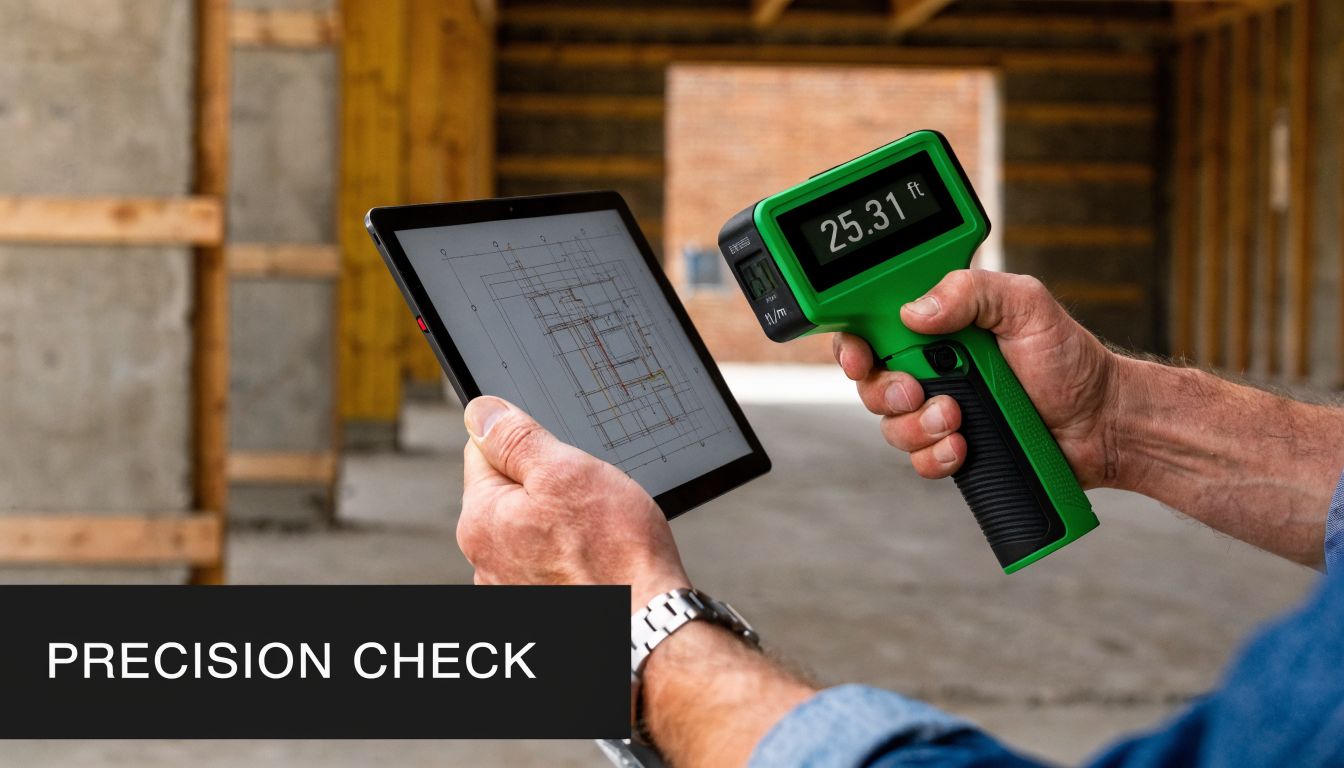
Not every change needs a high-end capture method. But complex services zones, plant rooms, congested risers, façades, structural interfaces, and underground conditions deserve more than hand sketches.
According to benchmark data cited from the 2024 Master Builders Australia National Construction Report, 85% of large capital projects in Australia over AUD 50M experience MEP deviations averaging 15-20% from design due to site-specific clashes. The same verified material states that using laser-scanned point clouds at 5mm resolution for as-built updates, in line with AS/NZS 4773.2:2015, can sharply reduce future renovation and maintenance conflicts, as summarised in this article on accurate as-built components.
That aligns with what experienced teams already know. Services move. Structure shifts in real conditions. Access zones get compromised. If you’ve got a congested ceiling space or a tricky plant interface, laser scanning gives you a factual base instead of trade-by-trade interpretation.
Use the expensive capture method where uncertainty is expensive, not everywhere.
A short explainer is useful if you’re introducing this approach to site teams.
Make review part of delivery, not a scramble
Flawless delivery comes from how the PM runs review, not just how the drafter edits sheets.
The review process should test three things:
Accuracy against the field
Walkdowns, survey checks, and photo verification need to confirm the drawing reflects installed work.Consistency across disciplines
A mechanical reroute that doesn’t appear on reflected ceiling plans, hydraulic layouts, or builder’s work drawings is still an incomplete record.Usability for the next person
A handover set should be searchable, named properly, and understandable by someone who didn’t attend the coordination meetings.
Teams that get this right also insist on metadata, document naming discipline, and a consistent file issue process. The package should not depend on tribal knowledge. It should explain itself.
One more point matters. PMs often focus on the drawing and forget the references. A complete as-built package is stronger when RFIs, approvals, red-lines, test results, and supporting records stay connected. When someone checks a future maintenance issue, they need the drawing and the decision trail behind it.
From Project Handover to Operational Asset
A lot of project teams think the job is done once the as-built package is uploaded and the training session is finished. For the owner and facility manager, that’s where the ultimate test starts.
The common failure isn’t that as-builts don’t exist. It’s that nobody can find the right one, trust the revision, or make sense of it without ringing someone who left the project years ago. That’s the handover-to-operations gap.
Why facility teams lose value after handover
As highlighted in this explanation of the handover and facility management problem, facility managers often can’t locate or interpret as-builts from projects completed years earlier. The challenge isn’t only producing the drawings. It’s keeping them discoverable, searchable, and useful for non-technical staff long after the construction team has moved on.
That problem shows up in ordinary maintenance tasks. A facility manager needs the final ductwork route above a ceiling. A contractor needs to isolate a service without cutting into the wrong area. A compliance check needs proof of what was installed. If the records are buried in old folders, split across consultants, or saved in outdated file structures, the owner ends up paying twice. Once to create the package, then again to rediscover the asset.
What makes an as-built usable in operations
Useful operational records have a few clear traits.
First, they’re easy to search. The user shouldn’t need specialist CAD skills just to find a riser diagram or drainage layout.
Second, they’re connected to context. The drawing should sit with the related references, asset identifiers, O&M information, and document history.
Third, they’re understandable by non-project staff. Facility teams need clear naming, clean indexing, and accessible formats. If every answer requires interpretation by the original project engineer, the handover has failed.
A good operational handover also recognises that the building will keep changing. The best as-built set is not a dead archive. It’s a controlled record that can be updated as maintenance, refurbishments, and replacements occur. That’s where the return on effort starts to show up. The owner avoids repeated re-surveys, reduces avoidable investigation work, and makes safer maintenance decisions because the project team left behind something usable.
An as-built drawing only becomes an asset when operations staff can act on it without decoding it.
That’s the mindset shift many construction teams still miss. The value is not in issuing the document. The value is in preserving the building’s memory.
Adopting an As Built First Mentality
The PM who treats as built drawings as a late-stage deliverable usually ends up chasing red-lines, arguing over revisions, and apologising during handover. The PM who treats them as a live project record runs a cleaner job from the start.
That’s the fundamental shift. As-built first doesn’t mean more admin for the sake of it. It means recognising that every field change creates future risk unless it’s captured properly. Some of that risk is legal. Some of it is financial. Some of it lands with the facility team years later when they’re trying to maintain a building with incomplete records.
The practical standard is straightforward:
- set ownership early
- capture changes as the work happens
- verify regulated and measurable elements properly
- review the package before closeout pressure hits
- hand over records in a form operations teams can use
If you do that, the as-built package stops being a contractual burden and becomes part of asset quality. That’s good project management. It protects margin, reduces disputes, supports compliance, and gives the owner something they can rely on after the site sheds are gone.
Many teams already know as-builts matter. The difference on better-run projects is that they act like it from day one.
If you want a cleaner way to manage drawings, revisions, markups, approvals, and handover records in one place, Doclio is built for exactly that. It gives project teams and facility managers a single source of truth across construction and operations, with searchable drawings, version control, linked documents, structured collaboration, and AI-assisted comparison that helps turn as-built information into something people can practically use.
Written with Outrank